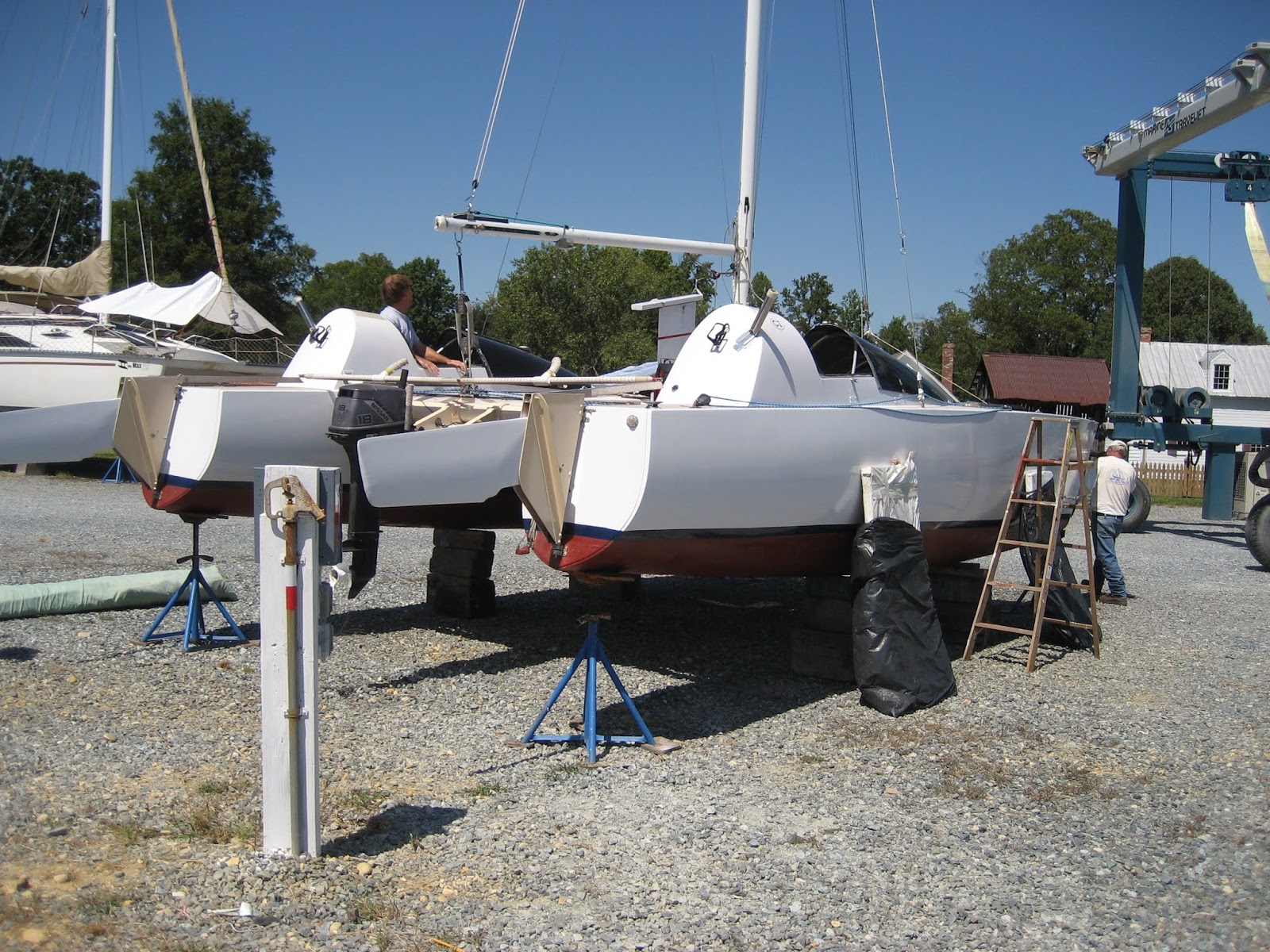
A New addition to the Bookstore
I started started sailing on a beach catamaran. I heartily recommend learning on a small boat, because they teach a sense of the wind and waves that is hard to gain on larger boats. But if you want to go farther or spend the night, you really need something with a bunk. But you don't need 50 feet of shiny fiberglass and the mortgage and slip fees that go with it. That's what they sell in the mags because that's where the (your) money is.
And to be honest, big boats aren't that much fun to sail, not after you get the hang of it. They're more about learning the systems and planning than actually sailing. Would you you rather go for a bike ride or drive a Winnebago around town? Personally, I'd take the bike, and that is why I downsized from a cruising cat to a 24-foot trimaran; the smaller boat sails better and I feel the wind again. I missed that on the cruising cat.
The thought that brought fire to my pen is that too many sailors feel that sporty boats are for racing. Poppycock. They are for whatever is fun, and if you only take the plunge, you'll see that fast cruising is a blast, though it can be a bit more like camping that staying in a hotel. Of course you can do both; sail fast from point A to point B, and then stay in a motel.
And that is the sort of thinking that goes into cruising fast and small. Ignore the magazines and make it work. You've never had so much fun!
Pages
- Home
- Introduction to Sail Delmarva
- Site Map
- Anti-Chafe Gear
- Marine Winterizing Primer
- Man-Overboard Recovery and Climbing Gear
- Holding Tank Odors vs. Carbon Vent Filters
- My Other Blog (Chesapeake Gunkholing and Kayaks)
- The Purpose of Work
- Diesel and Biocides
- Practical Sailor Magazine
- Good Old Boat Magazine
- The Bookstore
Showing posts with label Stiletto Stuff. Show all posts
Saturday, June 1, 2019
Cruising Small, Cruising Fast
Labels: Guide Revisions, PDQ Tips
Anchoring,
Books,
F-24 Tips,
jacklines tethers and harnesses,
Repairs and Maintanance,
Stiletto Stuff
Monday, February 6, 2017
Why Bow Sprits on Cruising Catamarans?
I thought about adding one to my PDQ. I really did, after seeing all the pretty ones at the boat show. I had the surplus parts all lined up to build a good one for $20. Then I came to my senses, realized they are nothing more than marketing bollox, and perfect my bridle instead.
I do understand why they exist. My first boat, a souped-up beach cat, had one to carry a chute, and the boat was considerably faster than the wind. Even reaching deep downwind, the apparent wind remained forward of the bow. Jibing through 90 degrees I would actually tack, with the eye of the wind coming from in front of the boat, not from behind. Same with my Stiletto. Fast boats.
A bowsprit increases projected area, allows a larger chute, and most importantly, it provides enough separation between the spinnaker tack and forestay for fast inside jibes (remember, these boats actually tack down wind).
But the math on a cruising cat, even a relatively fast one is very different. The fastest course down wind moves the apparent wind well aft. Jibes are outside because the apparent wind moves astern when jibing. Thus, a bridle provides more projected area and reduces the chance of running your sheets over mid-jibe. It is also lighter, does not contribute to pitching, and does not pound through waves up wind.
(With a bowsprit that long, the sheets are way out there. Just a little slack, the lazy sheet goes in the water, and a second later it is around the keel. Catamarans are less prone to this because the broad bows catch the sheets.)
This is what you actually need. Lighter, faster, stronger, cheaper. All the good words.
(Excerpt from up-coming book on Cruising Faster.)
Labels: Guide Revisions, PDQ Tips
Books,
PDQ Tips,
Repairs and Maintanance,
Sailing Tips,
Stiletto Stuff
Monday, September 1, 2014
Sifting Through Old Pictures
rev. 7-24-2024
Sometimes the basement needs a little cleanup, and since a knee injury has me sidelined from sailing and heavy work, sifting through a box of old pictures was worthwhile enough.
My first boat, a Prindle 16, built about 1984. Photographed with my mother and grandfather. This was the first day sailing with my new asymmetrical chute. Because the they were nearly unheard of on beach cats, kits weren't available, and I had no money, we sewed this one from a pattern of my own design. Very fast. Later I added aluminum hiking racks, a bow sprit, and some additional roach, which really made her into a speedster that tacked downwind.
She taught me how to sail tender boats fast.
Our first week with our Stiletto 27, Cherokee Sun, built in 1981, photo 1992. Later she got repainted, I added a chute, a bigger motor, and some limited cruising amenities.
The Stiletto taught me to sail tender boats even faster (this one tacked downwind too, with the chute), without capsize, and whetted my taste for cruising. Really, it was having a daughter that got me into cruising. (I went kayaking with my daughter today--she's all grown up and teaching 2nd grade now).
Jessica's First bluefish. Fun stuff. She taught me how to stay a kid.
Labels: Guide Revisions, PDQ Tips
Just Thinking,
Stiletto Stuff
Sunday, January 2, 2011
Stiletto Footage
Such a fun boat to sail. So easy and fast. I miss her... on nice days.
Of course, the PDQ will get, if the wind is up, but right now I'm stuck at home with a head cold.:
http://www.youtube.com/watch?v=rtfdWc1BuDY
http://www.youtube.com/watch?v=HrAi8Uuek4Q
Only the last clip is mine; I shot it just because someone asked about wave action under the deck, up-wind.
Vintage footage, from the original promo; So 70s.
Knuckle head sailing; lots of helm because the traveler is ridiculous... and yeah, I'm not so old that I missed the bikini:
http://www.youtube.com/watch?v=1PbZvfqlcHU&feature=relatedAnd some more hedonistic stuff:
http://www.youtube.com/watch?v=mfE3A2NVqEA&feature=relatedOf course, the PDQ will get, if the wind is up, but right now I'm stuck at home with a head cold.:
http://www.youtube.com/watch?v=rtfdWc1BuDY
http://www.youtube.com/watch?v=HrAi8Uuek4Q
Only the last clip is mine; I shot it just because someone asked about wave action under the deck, up-wind.
Saturday, May 30, 2009
My beloved Stiletto, Cherokee Sun, is... sold.
(Dragging the engine to slow the boat for picture-taking, still moving well in very light air)
I was saddened to let this great boat go - I h ave been taking her out for "exercise", even as I work on my new boat. I am always reminded that she must be the easiest to handle, fast, fun boat available. A swift racer, the ultimate day sailer, and a capable coastal cruiser in the hands of the adventurous.
Anyone intersted in these boats should read about them at http://stiletto.wildjibe.com/cgi-bin/forum/view.cgi.
I imagine fresh paint helped. Britesides, rolled without tipping (mohair roller, get the solvent right.)
Saturday, February 7, 2009
The Stiletto 27 - You Can Actually Sleep in That?
I freely admit it: I take great pleasure choosing adventures that seem a little bold to the casual observer, and I do as little as possible, at first, to dispel the mystique. My first loves were rock climbing, mountaineering and ice climbing - they share traditions firmly rooted in the collection of bragging rights. I've worked hard to build some skills and to plan, and I will revel in the results. Distance cruising in a small boat always hints at improbability. That we chose some waters few sail... all the better.The first question about the Stiletto was always "can you actually live on it? Is there a place to sleep?" Well, just. My daughter is small, I am used to backpacking tents, and compared to those it is at least luxury camping. At least you don't carry your home. As the illustration shows there are 2 comfortable bunks, narrow and lacking sit-up room, but long. The other basics are there and no more. You live on-deck.
I cheated though; I took my daughter, who I knew would keep my spirits up. Anything seems possible with ambition, a kids dreams, and enough stout.
Would we do it again? We made many long trips. The weather is the key: warm, always a plan for lay-days, and always a way - an inner passage - to avoid the worst weather. In the end we moved up to a PDQ Altair... really, enough is enough. No, that's not it; the desire to go further simply overcame fiscal sensibility.
Friday, February 6, 2009
Short Summer’s Cruise
August 2008 My daughter and I have gone on numerous trips around the Chesapeake Bay and around Delmarva—usually we aim to visit places that are out of the way new to us. This trip was different; we would be visiting familiar places, but favorites. No soulful experiences, but a pleasant trip I thought worth sharing, and one any sailor with a shallow draft boat and access to the central Bay should consider.
Day one Deale to James Island 22 miles
After delicately prying my 13-year-old daughter out of bed, driving the boat, and packing our supplies into the limit storage space our catamaran provides, we left the dock at about 10:30 a.m. A modest Northwest breeze sent us on the broad reach of about 6-8 knots under full main and spinnaker. Gradually the wind lightened and moved dead aft, and her speed dropped to 3 or 4 knots, but we had nearly arrived and motored the last few miles of approach.
James Island used to be a very sizable island, in fact a peninsula on the south shore of the Little Choptank River. However, with falling sea levels—yes I do mean falling sea levels, since it was a sandbar formed when sea levels were much higher—it has eroded into three islands that will probably disappear in my lifetime. You'll not find a description of James Island in any guidebook and little on the Internet. I spotted it on Google Earth as a lonesome spot with potential, researched on the Internet that the owner doesn't mind visitation by low impact users, and stopped by briefly on a trip earlier this summer, while passing from Smith Island to St. Michael's. What we discovered was one of the nicest little desert islands on the Chesapeake Bay. The east side of the center island forms a beautiful sandy crescent, protected from all but east winds. From any other direction doesn't look like much.
We arrived mid-afternoon, anchored near the shore and next to two small powerboats. We walked the length of the island to reacquaint ourselves with the beach. Jessica explored the tidal pools at the north end. She then began to lead me through the brush and in the middle of the island… and within 15 seconds came charging back at me, followed by a cloud of flies and mosquitoes. Her assault on the interior of the island had been repulsed.
The rest of the afternoon was spent… well, not really doing anything. That's an odd choice for an adult like me, who is inherently goal oriented. Not that I'm a super achiever in business. Not that I'm a workaholic. But my goal is to go sailing I want to go sailing well. If the goal is to go rock climbing, I want to climb well. Today my only planned activity was to relax, and I suppose I did that well. With a book in hand, bug spray applied to the back of my neck, my boat anchored 30 feet off the beach, and the calm sandy bottom on which to plop my butt (chest deep in the 80 degree waters of the Bay), I proceeded to think about very little for the next few hours. I fished a little, but only tiny croaker and spot were biting.
We settled down for the evening. A passing thunderstorm grazed us, providing some fresh air but no rain. We watched a Jackie Chan movie on a portable DVD player. We tried fishing again—I reasoned that if there were small croaker during the day there might be larger fish at night—and we cleaned up. One fat fish after another, all over a foot long. “Fishbites” was the trick, an amazing fake bait. I tossed the cleanings off the stern, attracting squadrons of smaller fish.
Day two James Island to Santa Domingo Creek / St. Michaels 20 miles
Unexpectedly the wind kicked up from the east northeast during the night. Though my daughter was soundly sleeping through it, the 2 foot waves we that rolled in woke me up rather early. The bottom is hard sand and with two anchors down there was no concern of dragging, but there was no chance of sleeping either. It was easy enough to raise sail right at anchor and to sail the entire distance to broad Creek in one tack, not at any great speed, but with perfect relaxation, the sun working its way up through the morning clouds.
Once at the head of broad Creek it's necessary to drop sail and motor up to the end of San Domingo Creek. A close examination of the map will show this creek provides a nice backdoor to St. Michael's; by anchoring near the town commercial dock at the head of the creek, or even running a very shallow draft boat ashore it is possible to gain access to St. Michael's without having to go all the way around Tillman Island. It's also free. Don't tie up to the face of the dock; commercial use, unloading crab boats, and recreational craft are not welcome there. It is possible, if your boat is very shallow, to tie up near where the dock and land meet, in water that is useless to larger workboats.
We walked the town, got ice cream, shopped the shops, visited the Maritime Museum (very nice - touring the inside of a screw pile light like the one at Thomas Point, is a highlight), stopped for lunch, and managed to get back to the dock just in time to beat a thunderstorm. Well, we didn't beat the thunderstorm. We managed to get about a half a mile before we had to quickly anchor in a small cove and dive below decks. I don't mind rain but I do mind lightening. The storm passed quickly, we motored about 5 miles toward intended overnight stop near the mouth of Broad Creek, anchoring securely in a small cove near another town dock. Nothing remarkable there, but we pottered around shore for a little bit, until the sound of thunder became undeniable. The passage of the storm itself would fill a small posting—sufficient to say that wind to 60 knots and hail were predicted, and they arrived. It certainly seemed that some god was throwing buckets of water filled with gravel at the hatch, as we surged back against the anchor. I had 2 well set hooks in and we didn't move an inch.
This too passed, I was able to take my time grilling up the fish we caught the night before, served with corn on the cob and rice. We enjoyed this in peace and quiet while watching another movie, “The Maldonado Miracle.”
Day three Broad Creek to Deale 20 miles
This should have been an uneventful day, except that the wind was blowing on the nose at about 20 kn and the waves were running 3-4 feet. There isn't much to describe other than sailing to the weather under reefed sails and getting wet. Within the hour we shook out the reef and continued under full main and storm jib as the wind moderated a bit, and the waves get smaller as we reduced their fetch. Worth mentioning perhaps, is that storm jibs are not solely for strong winds. Going to the weather I will normally go to a full main before changing up to the next larger jib. I find that even the smallest jib does a good job of cleaning up airflow to the main and giving the boat a wider bucket and more punch, but it is still a nice flat sail and feathers easily with the occasional gust that would otherwise overpower the boat. The mainsail is easy to feather; a larger jib is inclined to flap, and then grab, flap, and then grab. If you ease a large jib, it simply becomes more full; exactly what you do not need in strong winds.
That is the end of the story. Not much the story really; more of an invitation to visit James Island and to visit St. Michael's by the back door. It makes a wonderful three-day cruise, particularly suitable for smaller boats. Kids help too.
Labels: Guide Revisions, PDQ Tips
Stiletto Stuff,
Trip Reports
Subscribe to:
Posts (Atom)