Eyes outside of the cockpit?

A sailboat needs to show red and green sidelights when sailing (no all-around white, as when motoring).
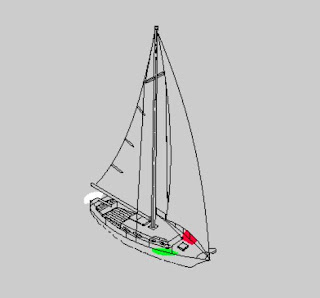
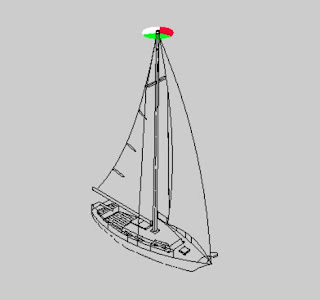
Boats under 20 meters can substitute a tricolor at the top of the mast. (Not a masthead light BTW--that is a steaming light located on the front of the mast, AKA a steaming light. A confusing matter of COLREGS definitions.) The primary advantage when the rule came out is that fewer bulbs and fewer amps were required. Additionally, it can be more visible in waves.
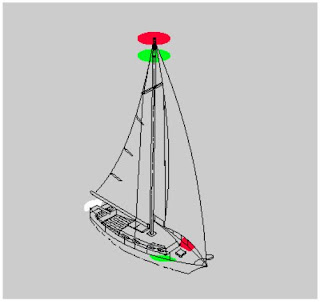
What lights do you show when lying to a drogue or sea anchor? You are not anchored. You are not underway in the standard sense, since you cannot maneuver. The answer is RAM. This also includes night diving.
But you can't buy hoistable RAM lights, certainly not any suitable for the limited power supply of a sailboat. So I made my own from LED clearance lights, which are cheap, low draw, and weatherproof. The assembly is >1000-pound tensile strength (tested), so I can rig it tight for rough weather.
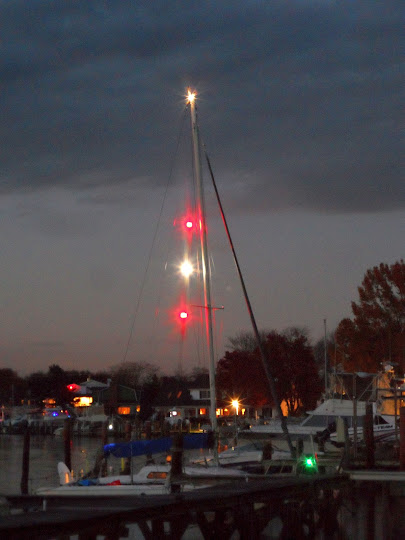
Bright enough? The top light and green light are USCG approved lights. The small white light on my backstay, just above the boom, is another "emergency anchor light" that is clearly not bright enough.
I'm testing them for at least 6 months before I roll it out.
Why would I want RAM lights? I dive at night ocationally. This will keep me seen.
Divers boats show the alpha flag by day.

But at night, lights are required. Only commercial dive boats are equipped to show these, but there is no recreational exemption. This is not a dive-specific light combination, but the standard "restricted ability to maneuver" (RAM) combination defined in COLREGS. It is combined with either running or anchor lights, as relevant.

Curiously, these are the same lights you should show (USCG) in some other unusual circumstances:
Some others are less clear:
Remotely piloted vessels also show RAM unless under close pilot control (USCG).
Without RAM lights, you are not allowed to show anything other than standard running lights. I would sure like to have something more obvious up there. The only other option is a distress light, which is not what I want.
It is not for conditions where your motions are unpredictable. "Not under command" may be more appropriate:
Obviously, you could build these lights, but red all-around lights are big and expensive. Over $500, lots of amps, and heavy. Same with hoistable lights. You would think there would be some reasonable hoistable solution on the market for recreational divers, but I can't find it.
Ideas Welcome!
up-date. 1-14-2022
A so-called emergency anchor light is rigged at the end of the boom. Not very visible and fragile. The RAM lights are highly visible (for foul weather) and draw only 0.9 amps total. The RAM units can also be unplugged (it is modular) and used as cockpit and cabin lights (white or night vision-safe red. And they are physically rugged and waterproof.

Nothing too specific. But in Coast Guard Nav Rules FAQ post the following is offered:
13. Where do Kayaks and Canoes fit into the Navigation Rules? Kayaks and Canoes are a vessel under oars and are addressed specifically in Rule 25 (lights)
Although a vessel under oars may be lit as a sailing vessel,
one should not infer that they are considered to be a sailing vessel for
other Rules (i.e. Rule 9, 10, 12, 18 or 35). Ultimately, the issue of whether a vessel under oars is the give way or stand-on vessel would fall to what would be required by the ordinary practice of seamen, or by the special circumstances of the case (Rule 2), and, the notion that they are less able than most other vessels.
Per Rule 25(d) they must be lit with 1 of 3 options between sunset and sunrise:
I'm rather puzzled at why the original means of power did not rate definition and specific discussion. Yes, some of this is obvious, but still. Why not spell it out? Sure it varies a lot. Perhaps it is because the maneuverability of a kayak compared to a cruising boat with a sculling oar are very different, bu the same could be said of a Sunfish vs. a tall ship.

The USCG has approved a new SOS beacon standard that flashes red/orange, cyan, red/orange in the familiar SOS pattern. Learn to recognize it.


Although not as bright as a flare, IMO they are more recognizable than a hand-held flare. The USCG wanted to replace flares with something safer. They also last 6-8 hours, which is a huge improvemtn over 4 x 3 minutes.
Note: you also need to create a hanging bridle. Some are simple, some require a little thought. Do this NOW, before you need it. Hanging under the boom works well.


---
After trying to buy flares last years, and being greeted with old stock (only 24 months left), I switched to an electronic beacon. Overtime it will be cheaper, and I believe it is better.
You still need a day signal. VHS and cell phones are still important. Offshore parachute flares are still conspicuous at long range.

Rev. 7-25-2024
I've been testing this and other brands for four years. See other articles, but the short version is that they are probably more recognizable as a distress signal than flares because of the SOS pattern. A flare that only burns for 3 minutes is easily dismissed as a trick of light, a nav light, or just missed.
I went to WM marine to get flares. They were 18 months old, out of 36 months,
and the store manager didn't understand the words "discount." To me,
they were 1/3 value, since I will get only one season from them. Most often I get only two season out of flares
because they are seldom "fresh" when bought.
I'm thinking of just getting the Orion e-flare. Yes, visibility is less, but realistically, with cell phones and VHF,
the odds of a primarily day sailor like me using a flare are between
zero and none. I've lit old ones for practice, but I've never even seen one on the water. On the other hand, the odds of me being stopped by the Maryland DNR
for a safety check are about once every 3-4 years, most often when they are checking fishing permits and catch.

Rev. 7-25-2024
I don't mind climbing that much, but bulbs burn out or corrosion ruins the connection at the worst times, and I'm not climbing up there a some rolly anchorage at the end of a long day, after dark, not just for a damn bulb. It's happened for the last time.
The rule does not say it has to be at the masthead. It says where it "can best be seen," which in my opinion--and many sailors agree--is absolutely not the masthead. Mostly it just looks like a star, way up there, giving no clue as to how far away it is, or helping anyone to actually see the boat. It can be confused with shore lights from a distance, and in an anchorage full of overlapping boats with lights of variable brightness on masts of variable height, it's just confusing. If you are moving directly towards the anchored boat, the shift of the light against the background is not easily noticed, and on a cloudless night there is no background. Every year high-speed dinghies and runabouts strike boats they didn't see, marked by a single light far above their view line. I have always left a cockpit light on in crowded anchorages (LED), which alone is more visible than that useless masthead light, since it lights up the boat and warns off drunken late-night navigators. That is what I do when the masthead light fails, generally adding a cabin light for good measure if in a crowded place. In most creeks, the cockpit light is enough. It would also be nice if I could reach it or at least lower it to the deck for maintenance.
1. A pole on the stern.
2. On the hard top, forward and inside the shrouds.
3. Add a plug an run something up the flag halyard.
4. Use the steaming light and stern light in combination. That gives 360 white coverage.
Commenters have mentioned that sealed LED will solve the reliability problem. Additionally, LED is the only rational answer when power consumption is considered.
Whatever I do will meet the 2-mile viability standard. No point in tempting liability.
Other ideas? But the masthead location is nonfunctional in my opinion.
----
rev. 11/24/2016 (correction 7-25-2024)
Several posters on the PDQ Owners Forum suggested the Davis 3300 Mega Light. LED, photo cell,
tiny power consumption, plug-in, and deck lighting too. Sounds like the answer.
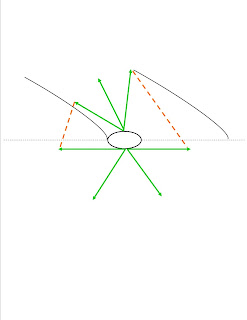
Unfortunately, based on testing by Practical Sailor, it does not come close to meeting the COLREGS visibility requirements when fitted with an LED bulb. The problem is that the bulb emitter is in the wrong position relative to the lens and that most of the light is focused into the water when hanging. It does not work.

The light cone is angled down and is not bright on the horizontal plane.


