Showing posts with label F-24 Tips. Show all posts

Saturday, October 26, 2024

The Goofy X-Spread Rig on The F-24 MKI

10-26-2024, rev. 11-6-202, rev. 11-27-202, rev. 12-7-2024

The failure of an F-24 mast at the lower diamond wire junction this week (not my boat) started me thinking about the odd rig on this boat. It was not used on any other F-boat, and in fact, no other boat that I can find. Supposedly Gino Morreli designed the rig, but he's a smart guy and he never used this design on any other boat. I'm think it's far more likely this was a John Walton (son of Walmart founder Sam Walton) design choice, one of many that Ian did not approve of. Oops.


 The failure point was just above the lower (forward) diamond wires. Note also that it was sideways (as typical), not in the direction of the forward wires, suggesting to me that they are not helpful.

Mono-hulls are typically rigged with spreaders and shrouds anchored to the deck. This provides side support with no added compression load. The proportional stretch of the uppers and lowers insures that the mast remains accurately in column, even as it is slightly deflected to the side under wind loads. Masts, when they buckle are failing in compression. Occasionally a jumper diamond is provided on the front to control the bend of a very slender mast, though larger mast sections and those stabilized with pre-bend typically do not require this extra support.


One the left (F-24) rig there are two sets of diamond wires on each side. The drawing omits the outer set on the left and the inner set on the right for clarity. Those are not loaded when the mast is pressed to the side and forward reaching.

 Re. Center of effort.  According to calculations based on ABS (American Bureau of Shipping) documents, the force on a sail is primarily concentrated on the head, clew, and tack. A quick look at the reinforcements and the arraignment of fibers in load path sails makes this obvious. Consider how the luff is relaxed when the sail is backwinded. In fact, about 65% of the sail force above the boom is concentrated at the head, with the balance spread along the luff tape. The load is NOT uniformly distributed along the mast, as commonsense might first suggest.


The weird F-24 X-spreaders. The forward spreaders hold the shorter wires. The aft spreaders are about the typical rake angle and provide the pre-bend. 


 F-24 manual image.


Multihull masts are often rigged with big rotating masts for several reasons. A big main is advantageous, as it provides accurate heel control through twist and easing the mainsheet. They can tolerate a heavier mast (rotating masts must be heavier because the staying is less efficient) because they heel less and as a result, the mast is not outboard, contributing to heel. They have a wide shroud base, reducing the need for spreaders to create angle. Often multihulls cannot sustain high mast base compression loads because there either is no center hull, or in the case of trimarans, because it is lightly built, without the need for structure to support a keel.  For the same reasons, rotating masts are nearly non-existent on monohulls. Because there can be no fixed spreaders to carry side loads, rotating masts use diamond wires, and it works out well that they rotate with the mast, supporting the weak side of a thin, aerodynamic wind section. Forward support isn't needed, because the mast is wide in that direction. The diamond spreaders are angles aft to help create some pre-bend, which helps with mast stability (resists inversion and pumping) and with draft control (you can de-power by de-rotating the mast which pulls cloth out of the sail, reducing draft).

 The combination of diamond wires, aft-swept spreaders, and aft-angled cap shrouds also helps eliminate the need for a fixed backstay, something that is problematic with a high roach mainsail, the other half of the quick-heel-control formula. It's hard to maintain enough forestay tension without a backstay, and savy multihull sailors quickly learn to compensate with a tight mainsheet.

But the F-24 MKI mast does not rotate, so why the diamond wires, instead of fixed shrouds? It's easier to step the mast when trailering, since no tensioning is required. The center hull is relatively narrow and very light, with no good place to anchor the shrouds. There is also the need for aft-raked cap shrouds to replace the backstay. Of course, many cruising cats have either conventional shrouds or diamond wire stays with aft raked cap shrouds and no second set of diamonds.


There are several problems with the willy-nilly addition of stays without working through the design. When a mast fails, it fails in compression. Like buckling a drinking straw, the tensioned side does not tear, it is always the compressed inner side that buckles inwards. Every additional wire and its associated pretension adds compression, so unless it provides needed support, it actually weakens the mast. The more wires, the more compression. Calculations of buckling strength for this mast sections give a compression working load of 6,500 pounds. Rough calculations based on wind pressure and heeling force (the boat was reefed and very close reaching) and bending moment at the failure point  show that the mast failed under a compression load of about 12,000 pounds (if distributed--this reflects the probable stress on the side that failed). This is well over the safe working load of the section, but less than the expected failure strength.

If we total up the compression loads from the shrouds, diamond wires and other rigging ...

  • Forestay. 2200 pounds
  • Shrouds (only one is under much tension sailing under full load). 1200 pounds
  • Mainsheet. 300 pounds
  • Halyard, jib. 300 pounds. Note, jib halyard tension does not change forestay tension + halyard tensions at the mast, only between the mast and the anchor point at the furler. The total is fixed by shroud and mainsheet tension contributions.
  • Halyard, main. 500 pounds
  • Cunningham. Does not count, since it just offsets friction in the mast groove, from head to foot.
  • Forward diamonds. 1000 pounds total (but not included at failure point)
  • Aft diamonds. 2400 pounds total

... and adjusting for angles (only part of the tension is directed in-column) we get about 6,500 pounds total. That does not allow a lot for bending moment. Curiously, 36% of this is from the diamond wires and 10% from the forward diamonds, which we don't need; there is very little forward load on the mast, and the center of the force is near the head of the sail (forces perpendicular to the luff tape are very low, except near the head and tack--not the wrinkles, the luffing when backwinded, and the lack of significant reinforcement on the slug grommets).

The rigging guide gives 500 pounds max for the forward diamonds and 1000 pounds max for the aft diamonds. But what if they really don't need pretension for stretch, since the mast is not bending? Then the pretension for the aft shrouds needs to be just enough to establish the prebend (0.8% of length), and forward diamonds just enough to keep them from going slack, since we probably do not need them at all. But I'm disinclined to remove them entirely, and going slack might allow them to jump out of their fittings. 

10-29-2024. I checked the tensions on my F-24 MKI.

Wire                  Observed (pounds)              Maxium Spec (pounds)            Re-set to (pounds)

Shrouds             800  (may reach spec in strong winds)  1500                       (adjusted each sail)

Forestay            (same as shrouds by geometry, except as increased by mainsheet tension)

Aft Diamond     1400 (over spec, below)      1000                                           800

Fore Diamond    800  (over spec below)       500                                             350  ____________

Total Diamonds  4400                                    3000                                           2300

 This represents a (4400-2300)/6500=32% reduction in mast compression, which translates dirrectly into a 32% increase in strength. 

Data source: from the 1992 F-24 manual


 Worse, exactly where the reefed main applies it's greatest force (65% of the drive above the boom), just above the forward diamond wire anchors, the lee diamond wire is pulling down and to leeward. And that is where the mast buckled to leeward with a reefed main. The smoking gun. Removing or slacking the forward diamonds also reduces this stress. 

What if the mast raising stays were snugged and perhaps reinforced in the deck (Lower shroud)? This is a conventional rigging solutions? This stabilizes the lower mast with less compression in the critical area. It would also help to move the anchor point slightly aft and outboard, while staying inside the jib track.

Takeaways? The forward diamond wires increase compression and pull in the wrong direction without providing any useful improvement in mast stability. Best would be a re-designed mast with only one set of aft-swept spreaders. The less drastic solution is to reduce the tension on the forward diamonds; I judged 300 pounds to be sufficient preload and sailing observations confirmed they do not go fully slack.The aft diamond wires should be just tight enough to create 2.5 inches of pre-bend (as specified by Ian Farier)  and no more. These serve a purpose, but extra tension does not help. 800 pounds appears to be sufficient, and I may reduce this, based on further sailing observations in strong conditions. 

Will I reinforce the deck and improve the lower shroud? Undecided. No. The wires are too small to bother.

Time will tell, but I'm comfortable with my calculations. The mast should now be 30-35% stronger, no small improvement.

---

rev. 12-7-2024


A few more ideas. I could support the center by running a second set of shrouds to the same anchor point. In this way, they would move together.  In addition, they would be tensioned along with the cap shrouds. My gut is that fixing the diamond wires makes this unnecessary. I have to address the diamonds anyway.


Thursday, July 18, 2024

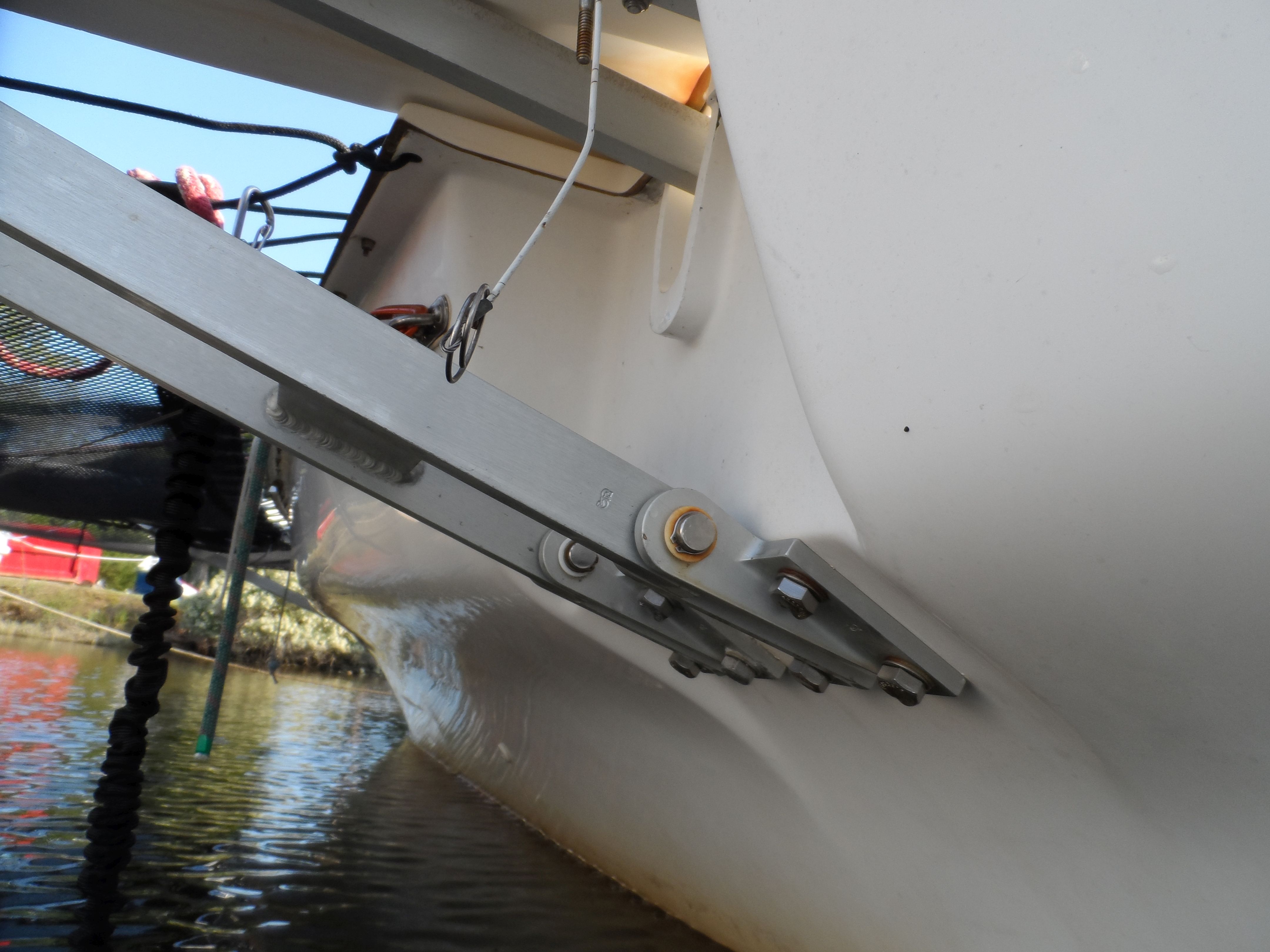
F-Boat Hinges and Stainless Bolt Failure

 Edit 7-19-2024. Edit 7-21-2024: I originally posted the images just to share them with a metallurgist. They deserve some explanation.

The bolts are not from my boat. They are from an F-9A, a home-built version of the Corsair F-31. The hinge design is similar. I know of three F-9As that have suffered from this problem and no other F-boats. I don't know why this is the case, but I have educated suspicions.

When the bolts fail, even if over 50% of them are bad and the others compromised, the structure does not fail. It is very conservatively engineered. Although stress certainly plays a part, I suspect it is only the pre-load (installation torque) and not service loads. As long as the service load does not exceed the installation pre-tension, the bolt does not "feel" the change in load. The fitting experiences changes in stress, but the stress under the bolt head does not change. This is one of the primary reasons for pre-tension (in addition to preventing loosening, but they are related). As long as the pretension does not exceed the working load limit (WLL) there is no fatigue, not change in stretch, no movement, no failed seals, and no loosening.

These bolts are loaded in nearly pure shear, so the failure point, if related to sheer, should be at the flange/hull interface or even farther in, not at the head. The fore-aft loads from the amas are carried by diagonal cables. The view is from the aft hinge forward. The forward hinge is just visible in the distance.

So why are they failing at this location, and why only (I think) on the F-9A?

---

 I asked the owner of one of the boats for more detail. This is what I go. He obviously put some thought into it.

All the ones (bolts, washers and nuts) I removed were 304 series (A2), it is isolated from the aluminium bracket with a glass reinforced acetal washer.  This sort of crevice corrosion is quite common in saline environments where a water film can get trapped and not flushed.  It is a significant area of interest in offshore oil and gas where the use of duplex steels (which have austenitic and ferritic phases) is common which are designed to be more resistant to this type of corrosion.  One of this issues is there is no great way to tell if a fastener has crevice corrosion.  PERN number, which is a ratio of  chromium, molybdenum, nickel, and nitrogen content is often used to compare the resistance of steel to this type of corrosion.  PERN is approx18 for A2 (304), 24 for A4 (316) and mid 30s for duplex.  I notice the farrier sailing manual suggests no maintenance is required except flushing the bolts with fresh water if feasible.

---

[Corsair F-24 lower folding strut. A smaller boat, but a similar design.]


Sometimes the head of the bolts come off due to crevice corrosion under the heads. Only under the heads. The bolts are epoxied in, creating a good seal, but who knows.  Another possible difference with this F-9A vs. the production Corsairs is the used of glass-filled acetal washers in place of 304 stainless washers. Was the glass possibly abrasive? There should have been no movement. Some other chemistry, possibly related to why bolts more commonly break inside the laminate?

These boats, unlike the production version, used carbon in the beams. Some builders used it extensively. Carbon is quite noble and could be a factor.

This is more like what I would expect, but it is not what we see on F-boats.

This can also affect hinge pins (F-28R).


The F-28R and the F-9A contains some amount of carbon, but whether it was used in the affect area is not known (these boats are on their 2nd owners). Certainly not near the failed pin.


More F-9A parts


---

I'm puzzled as to why these problems do not seem common in the Corsair production versions. I'm glad, mind you, just puzzled. As more information becomes available, I will revise this post.


Saturday, June 1, 2019

Cruising Small, Cruising Fast

A New addition to the Bookstore

I started started sailing on a beach catamaran. I heartily recommend learning on a small boat, because they teach a sense of the wind and waves that is hard to gain on larger boats. But if you want to go farther or spend the night, you really need something with a bunk. But you don't need 50 feet of shiny fiberglass and the mortgage and slip fees that go with it. That's what they sell in the mags because that's where the (your) money is.


And to be honest, big boats aren't that much fun to sail, not after you get the hang of it. They're more about learning the systems and planning than actually sailing. Would you you rather go for a bike ride or drive a Winnebago around town? Personally, I'd take the bike, and that is why I downsized from a cruising cat to a 24-foot trimaran; the smaller boat sails better and I feel the wind again. I missed that on the cruising cat.


The thought that brought fire to my pen is that too many sailors feel that sporty boats are for racing. Poppycock. They are for whatever is fun, and if you only take the plunge, you'll see that fast cruising is a blast, though it can be a bit more like camping that staying in a hotel. Of course you can do both; sail fast from point A to point B, and then stay in a motel.

And that is the sort of thinking that goes into cruising fast and small. Ignore the magazines and make it work. You've never had so much fun!


Monday, November 26, 2018

Northill Anchors

It seems quite a few have never heard of these, so I thought I would post a few images. I used one a bit with my Stiletto 27; it was better than Fortress in weed, rocks, and shell, and the new generation anchors had not taken off yet. I used it a little with my PDQ 32, testing in-line rigs, but never collected hard numbers; there did not seem much point, as they are long out of production. But I'm thinking of going back to it for my F-24, since it has a few advantages:
  • Folds flat
  • Very easy to assemble, better than any other break-down anchor (less than 10 seconds)
  • Works on any bottom type
  • Good reset behavior
  • Good holding capacity (450 pounds for 12-pound 6R Utility in mud), comparable to  many new generation anchors. The cross stock adds a LOT of holding power when it meets the bottom. I've tested this anchor to 750 pounds in fine sand and it didn't budge.
It has two disadvantages:
  • The lazy fluke is sticking up. A problem if the tide does a 360, which it can.
  • Unlike new generation anchors, it does not rotate to face a shifting breeze. Instead, it pops out like a pivoting fluke anchor. Fortunately, it is much better at re-setting. Thus, the fault is nearly forgivable. Considering fault one, it's not the anchor to use when tidal reversals are expected.
I still have the one shown below, and I think it is the right size for the F-24. All you do to fold it is unclip a carabiner and slide the stock out.

Northill 6R, 12 pounds.


They suggest a larger anchor, at least a 12R for a storm anchor for the F-24, but I carry a second anchor and I'm pretty good at reducing the load. And really, I'm just day sailing, anyway. If I start cruising, I'll find a nice cove for nights.

Tuesday, November 20, 2018

Why does the World Sailing Off-Shore Rule Forbid Wider Pulpits?

It can be awfully skinny at the bow. The obvious solution is to set the railings outside, a little wider:

I would like to see a beefy toe rail with this arrangement, required by the Off-Shore Rule. The rule also requires a mid-rail. Net is not required, but it would finish the job.

 The front curve is handy for suporting the bowsprit when foldedI like that the F-24 has a place to attach a safety line at the back corner. It reduces sail snagging and guards a gap.


But the Off-Shore Rule is rather specific:


 Not only does this make for a safer work area, it avoids jib impingement.


I'm confused. It seems like a good idea to me. I understand why this would be important farther aft, since rail meat would be sitting farther aft. but that is a different matter and easily excluded, if that is the intention.

Thursday, November 15, 2018

Hugo Boss Sets a Record, Over 38 Knots

On the other hand, I love my Farrier. I bet my dollar-to-grin ratio is higher. It better be, since I don't have the dollars.


Thursday, August 9, 2018

Sun Protection

The sun is a real bugger in the summer. I realize I was spoiled by the big hard top on the PDQ, now that I'm baking in the sun once again.

The water is wonderful, but the air is steamy.

Earlier this week, after enjoying a nice sail, I decided to anchor for a bit in the falling breeze, to eat lunch and eventually do some paddling along the coast. The first thing I did was rig an awning, which was a life saver.

I need to fine-tune the pitch, but this nylon tarp keeps the sun off. Notice some chipping of the paint.

I made it up 10 months ago out of a blue nylon tarp I had. Itis attached to the mast and topping lift, with straps around the shrouds and posts fitted to the stern pulpit. I didn't set the back corners  correctly for this image (I forgot where they went), but you get the idea. The white paint is nothing more than a single coat of Behr from Home Depot, casually slapped on; I learned from another boat that white really drops the temperature.


Which brings us to sails. Every self-respecting furling genoa has a sacrificial UV strip, usually Pacific Blue Sunbrella (which the sailmakers call "everybody blue"). It lasts until the stitching fails, generally about 5-8 years. You can either restitch it for another 5 years, or have it replaced for $400-$800. It's heavy but durable. Some folks use sail cloth or self-adhesive Insignia Cloth from Bainbridge; a waste if you ask me, since they only last 3-4 years.


And then there are light air sails, like this furling laminate reacher, that have no UV cover. We don't leave it up, partially for this reason, and partially because we don't use it most days. But it would be nice to leave it up, if only it had some protection....

You won't see me sewing a UV strip on it. Stitching a Mylar sail is like adding a tear-here perforation.

This jib suffered a 5-foot tear right along the stitch line. The cover was post-factory and the sailmaker that added the cover was an idiot (you need to insert a special scrim or layer of polyester before stitching Mylar). 

 We also know that paint can stick to sails. This is for advertising, not UV (mostly--it must help), but it does last a year.


Can paint provide a serviceable, light, and economical alternative to Sunbrella UV covers? Maybe it won't last as long, but on an older sail, does that really matter? Perhaps the $600 you save is more wisely earmarked for a new sail in 4-5 years.

I'm lining up some test paints. I think you will see a paint UV cover on my reacher in a few months. We don't leave it up much, so I'm sure it will be enough. I doubt the UV cover will ever fail on our Mylar genoa--the sail will explode first. Would I use paint in place of Sunbella on a new polyester genoa? Probably not, but perhaps for an old dog. On a Mylar jib? Yes, I'm thinking it might be the better value, if I can find the right paint. I already know that stitching a cover onto Mylar is questionable at best.

Thursday, July 26, 2018

Dyneema Anchor Bridle

"Bridles are made from nylon, right, to absorb impact?" Well, yes and no.

If the rode is all-chain, yes, at least 30 feet of nylon is required to take the sting out of waves and wind gusts. Since multi-hulls use bridles to reducing yawing anyway, a nylon bridle is an elegant solution.

I usually attach the bridle with a prusik loop from a Dyneema climbing sling, but a knot is fast in light winds and I had misplaced the loop. A knot weakens the line and jams if the wind is over 20 knots (25 knots for a figure 8 knot), so I don't recommend it.

On the other hand, if the rode is nylon, it's easy to have too much stretch, to the point where fore-aft surging is actually increased, This leads to more impact and more yawing, since there is slack in the system. Logically, there is an optimum amount of spring in the system for a given yacht mass and sea state. A chain leader is another non-stretch element. By tuning the amount of chain, other non-stretch leader, and non-stretch bridle, motion can be minimized. 30-40 feet of nylon is good in relatively sheltered areas, and  80-120 feet is the most that is advisable. As much 300 feet is used with sea anchors in storms, but the wave conditions are unlike anything you would anchor in.

The other concern is stretch. A nylon bridle distorts when the load comes more to one side. The more it distorts, the more the boat yaws, and the farther it distorts. With a multi-hull bridle this may increase yawing 10-20 degrees. With a narrow monohull bridle, it may distort to where there is no bridle effect at all. For this reason, non-stretch bridles are better with drogues and sea anchors.

"How about polyester? It is low stretch also?" In fact, I used a polyester double braid bridle on my 34-foot PDQ when I had a nylon rode. It worked very well and was easy to handle. Dyneema works on the F-24 because it is left rigged all the time and Dyneema presents less drag through the waves and weight. It is also very UV resistant and has the best strength/dollar ratio available. It fits the small bow eyes and does not fatigue. Because the rode is recovered from the center hull using the main rode, I never handle it under load. But polyester was better on the PDQ and any application where it might be handled under load, whether by hand or winch.

Always something new.

Tuesday, March 20, 2018

Outland Hatch Covers

September 2016

After nearly a year in service, 2-thumbs up and nothing I would suggest they do differently. A great product that is both durable and sharp looking.

Measure carefully (they are all custom cut), clean the hatch, and install on a warmish day.


Press the buttons on firmly.

 This one is located near the base of the mast, and thus, I've stepped on it many times.

Kind of pricey, but they do a nice job of keeping the sun out (the cabin is significantly cooler and the AC works less) and they can be left in place sailing. Although I would try not to step on hatches on principle, this hatch is at the mast, I stand near there every time I hoist or reef. As a result, they've been stepped on roughly a good many times in rough weather. Not at all slippery and evidently durable. One owner (Boat Galley.com) reported dropping a wrench from the masthead, saving the lens from a certain crack. The only evidence was a tiny dent.

March, 2018

After 5 years on the PDQ, I liked them so much (they are still like new), I added one to my F-24. The forward hatch gets stepped on a good bit and the cover offer some insulation, keeping the cabin warmer in the winter and much cooler in the summer. The the hatch lens will last longer (no UV), making it worthwhile for that reason alone.


Sunday, March 11, 2018

Fixing a Lame Bowsprit

It's not that I work slowly, but often I make changes in small increments, careful to make certain each change and the entire project is optimized. This one took nearly 6 months to completion.

I didn't photograph the original mess of cracked welds and failed screw repairs. I just ground it all away.  The original fitting did not cradle the butt end of the bowsprit and did not extend completely to the end.

The Failure. The original hinge mechanism included an undersized butt cradle that ended up cracked on most F-24s. It was simply under-designed.Often the sprit was also dented. There was no line to hold it up, and sheets often snagged down low, around the jib furler.

The new aluminum cradle is both wider and built from heavier material. The plastic insert is curved to match the pole. These dimensions are approximate--you will need to measure your own.
This should be as strong as the pole. However, I always tension the up-haul snugly to carry the opposing load, should the bobstay be inadvertently over-tensioned.

Larger bolts (#10) were tapped into the side pieces. Additionally, the cradle is wider and reaches to the end of the pole.

Then there was the matter of articulation. The original design incorporated a fix bobstay and could only be folded or extended at dock, or by hooking your legs around the pulpit and reaching for a pelican hook at the waterline. Not fun under way in any weather. Some owners fitted a tackle using blocks, but they're certain to collect junk and accumulate lime. Ball bearing blocks large enough to handle the sustained high load would be awfully bulky. I also wanted more purchase, to reduce the load on the line clutch. Enter low friction rings (LFR). Although higher in friction than ballbearing blocks, this tackle is not adjusted under load.

Fortunately Amsteel is super easy to splice. The yellow is a Dyneema Climbing sling. The safe working load of this tackle is about 3000 pounds, stronger than original.

I used rings from Antal, Ronstan, Harken, Nautos, Wichard, and Scheafer, all part of a Practical Sailor research project. Though I reported my favorites, they all work just fine. An up-haul was also added, not apart of the original design. This relieves the load from the butt cradle and keeps the reacher sheets from going under the pulpit where they can hang-up. It also secures the sprit against the pulpit when not in use (I wrapped a sort section of the pulpit with 3/16-inch line so that it would not bang when stowed). A lucky coincidence of geometry, the travel of the 4:1 down haul and the 2:1 up-haul are the same, making a continuous line a neat solution. Because Amsteel is slick, I covered (bury splices) the center section of the line with polyester cover so the clutches would hold properly.

A surplus Easy-Lock clutch is mounted to an aluminum plate (tapped), which is in turn mounted by bolts through the hull flange, neatly out from under foot. Another LWR keeps the line tail neat.


The final result is easy to use, and lighter and stronger than factory. The side stays are looking a little rusty, so they will be replaced with Amsteel soon as well.


How fast? Over windspeed on a reach. Mid-teens are common, though a little scary if it's gusty.

Wednesday, March 7, 2018

Getting my Small Boat Anchoring Mojo Back

I've done a lot of testing related to anchoring, almost always related to anchoring with all-chain. After all, that is what cruisers do. It is cut proof, reduces swing in tight anchorages, and is easy to handle with a windlass.

But my cruising started on a Stiletto 27 catamaran, weighing only 1300 pounds and anchoring with rope and hooks of no more than 12 pounds. Soft mud, sand, rocks and packed shell. I did a lot of things differently, by instinct, and now I'm determining by load cell and scientific method just how many of my judgments were right.

The new break-down 13-pound Mantus anchor is a godsend for shallow lockers, fitting where only pivoting fluke anchors once would. Disassembly takes only 20 seconds and requires no tools. This is the only new generation anchor that will work in this locker. The only other non-Danforth style anchor that fit was a 12-pound Northill Utility, which although a nice anchor, has an exposed fluke that is a little scary if you swing overnight.

Note the red webbing chafe guard. I use only 5 feet of chain, so this protects the first 20 feet of rode. It is slid over the first few links of chain and sewn in place, through a seizing might wear better.

I still like Fortress/Guardian Anchors for soft mud. They have no equal.  

Bridles and Snubbers. Multihulls always used bridles to reduce yawing. However, where I have long pitched nylon for use with chain, to reduce snatching, with a nylon rode the rule is reversed. A non-stretch bridle is more stable (does not bend from side to side), and by reducing the amount of nylon, horsing (fore-aft surging) is reduced. I used polyester double braid on the Stiletto and I am using Dyneema on the F-24.

Scope. I don't care what they say about new generation anchors holding at short scope. Based on every bit of theory and testing of many anchor models, it just ain't so. Because smaller boats can anchor is shallow water, long scope is no big problem. I very, very rarely use less than 8:1 scope.


Scope Holding
Greater than 20:1 100%
10:1  95%
7:1 80%
5:1 60%
3:1 30%
Less than 2:1 variable to nil

[This relationship is based on testing of anchors of all styles, including new generation, and holds true for mud and sand, and for sizes from 2 pounds to 5 tons. The exceptions are pivoting fluke anchors by Danforth and Fortress, which are much better at short scope, but only if well set first, which is basically impossible for most small sailboats (the engine is too small).]
<2:1 nil="" p="" to="" variable="">

Rode Size. Go bigger than recommended, not because you are paranoid, but because if you check the numbers, most rope recommendations seem to be based on fishing and lunch stop anchoring. I guess they figure you would use chain if you were a a "real" cruiser. Remember that the WLL is only 12% of the breaking strength (ABYC H-40, Table AP-1), and that is before UV and chafe are included. Finally, larger ropes are easier to pull by hand and wear MUCH slower (lower load/area and the rope fibers are under less stress).

Chafe Guards. We use tubular webbing on dock lines and mooring pendants to prevent chafe. Why not on the anchor rode? Because it floats loose, it is practically wear proof. 2-inch Blue Water ClimbSpec webbing slides over  a 1/2-inch chain splice and 1/4-inch chain. $0.45/foot.

Coating with Yale MaxiJacket or Flexdel RopeDip is also effective against chafe, but not cutting. It also stiffens the rope slightly.

Short Chain. I hate handling chain. If you have to use momentum to break out the hook and have no roller, chain will tear up the top sides.  I don't need chafe protection if I use a guard, and the rode + webbing cleats easily.  The weight of 10-20 feet of chain makes no difference once the wind is above 15 knots. It's off the bottom, I've checked. It doesn't change the way the boat swings. Skip the long chain.

Use Two Anchors. Not all the time. But learn how to lay two and you will see that it takes only a few minutes on a smaller boat. [One simple way is to set the first anchor at 20:1 scope, walk the second anchor to the stern and lower, and then bring the boat to about 10:1 scope and tighten them against each other. You can even use a cockpit winch. Then moor the second rode to the bow--I don't believe in fore-aft anchoring. Add 20-50 feet slack, since you  don't actually want the anchors in a straight line, you want a triangle.] .A particularly good idea if you have only pivoting fluke anchors, which don't like direction changes. The trick is to have a relatively short (100 feet?) rode on the second anchor so that if the boat spins, untangling is easy. Put eyes in the ends and it is easy to extend with needed, which will probably be... never.

Minimize Yawing. Taking the dingy off the bow helps (like a riding sail at the wrong end). Lift the rudder (moves the lateral plain forward). Take down the furling reacher. Use a hamerlock mooring.

Puny Engine? No Engine? Bump Set! After getting your initial set and deploying full scope, power set with reverse. Then gather up some slack and back up at speed; 2 knots for heavier boats, 3 knots for multihulls. So long as you have at least 50 feet of line out, the effect will be no more than a severe storm (I've measure the forces). No engine? Haul up slack and the let the wind push you back (you may need to wait until there is some wind).

----

I like to anchor with absolute certainty.