I'm going to come back to this topic. Placeholder.
Platino preventer rigging. Obviously, the leverage stinks and fatalities resulted.

©2018 Maritime New Zealand
I'm going to come back to this topic. Placeholder.
Platino preventer rigging. Obviously, the leverage stinks and fatalities resulted.
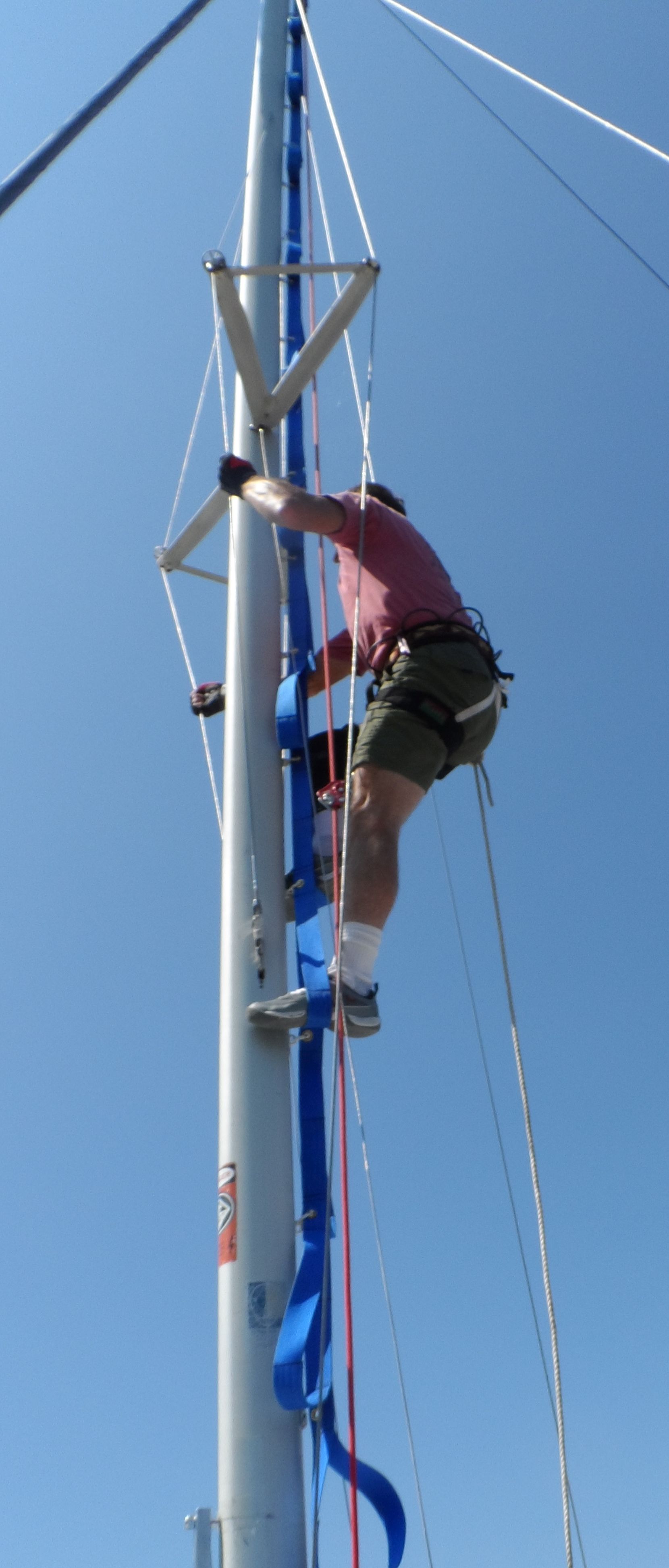
The Ladder. My 30-year old Mastmate is easy and fast to climb if:
Fall Protection. I use a Camp Goblin on a spare halyard. It glides up and down the rope unattended, but catches in a fall. Rated for this use, not an adapted ascender or belay device. You can see it floating near my knee (it must be extended on a short sling to give freedom of movement.
... Should corn go into fuel or food?
In the past, since I didn't favor ethanol in gasoline for environmental and operational reasons, it seemed obvious. Food was a better use. But if both are short, and the international situation matters both in terms of food supply and fuel supply, which is should win the calculus?
In the US, I assume the market will decide. The EPA's rules on gasoline blends have been relaxed, and the value in food and gasoline has gone up. Jump ball, I guess, since we have enough and export both.
In Europe, I'm guessing gasoline wins.
In the third world, I imagine food wins, except where sugar cane is used to make ethanol, there really isn't the same export demand for cane.
It's a shame people can't just play nice. I thought, or at least naively hoped, we had outgrown this, on this scale.
---
Assuming we're looking at E15...
Let's see...
Equals 6 gallons per year. At $5.00 per gallon, about 30 gallons per year or $1.25/trip.
Then there is the case of the guy with 3 x 250 HP on the back, burning $375.00/hour.
Then there are the fishmen, trolling for hours and hours at 3 knots. But really, they're only burning ~ 0.3 GPH at idle, so only a few gallons while trolling. Getting to and from the fishing grounds might be 5-10 gallons, if it's not far. So maybe $50-100 for the day.
Plus carfare. Plus slip. Plus, plus, plus.... Maybe I should just buy a fish sandwich, even at only 1 quart per trip.
On vaccines and masks:
A great flood happened.
A man was forced to climb to the second floor. He was looking out the window and a canoe passed. “Do you need help?” The people in the canoe called to the man. “Oh no, God will provide.” So the canoe went on it’s way.
The water kept on rising and the man was forced to go onto his roof. He was sitting there looking around when a helicopter flew close by and a man inside called, “Hey! Need a lift?”, and the man said, “Oh no, God will provide!”
The water rose even higher and the man drowned. He went up to heaven, met God and said, “I trusted you! You were supposed to provide!” And god said, “I sent you a canoe, and a helicopter!”
---
He gave us a brain, the brain gave us reason, science that explains the reasons for good hygiene, and vaccines. We should probably be gracious for the gift of reason and use it. (From me, a complete atheist.)
Times are changing and the bubble is opening. We are all thankful for the vaccine and natural immunities that have made this possible. But there is now a new virus in the world, it isn't going away, and we aren't going back to the good old days. In fact, the good old days were full of seasonal colds, the flu, polio, and lots of things that took children before they were adults, adults before they live a full life, and ruined our quality of life. They weren't really that good, and in fact, it seems we were just enjoying one of those idyllic interludes between periodic plagues, ice ages, and world wars.
Better to work our way through change, which is never easy. The pre-911 world is not coming back, but we have gotten used to it and hardly notice the differences unless we dwell futilly on the past, and some ways it is probably better.
Adapt. Immune compromised people will need to remain vigilant and they will have to take more precautions; annual vaccines and mask wear in many settings. Healthy people will need to be courteous to others and take a few precautions that seem unnecessary to them. In the future there will be no "cover your mouth when you sneeze" or "cough into your elbow." If you have a cold or even allergies, politeness and good hygiene will demand you wear a mask, and not to wear a mask when you have the sneezes will be fundamentally rude. If you think about it, it has ALWAYS been rude and inconsiderate to spread your germs and make other people sick, but we all did it anyway. Now we have better tools not to.
It no longer feels "weird" to wear a mask in the grocery store or office, so I hope we will when we should. It won't be all the time, but will be when we are sick or when some new surge comes along. It may be smart in an airport terminal, and on the same day superfluous in a quiet restaurant. We need to be thoughtful, and determine the difference, not based on politics or local fashion or the fashion of the moment, but based on the situation.
It comes back to reason. I'm looking forward to wearing a mask only as needed, and at the same time, if I can be smart about it, avoiding seasonal colds and all the rest. That would be nice.

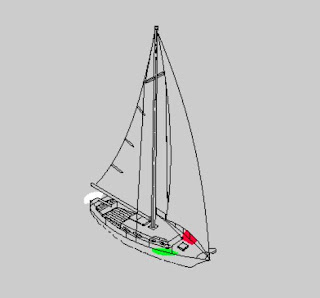
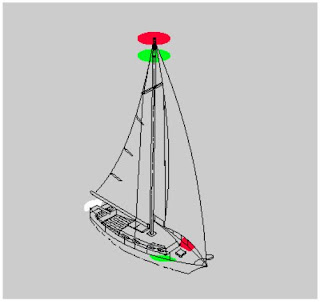
A sailboat needs to show red and green sidelights when sailing (no all-around white, as when motoring).
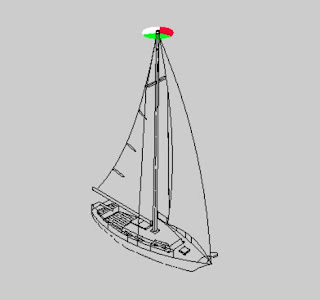
Boats under 20 meters can substitute a tricolor at the top of the mast. (Not a masthead light BTW--that is a steaming light located on the front of the mast, AKA a steaming light. A confusing matter of COLREGS definitions.) The primary advantage when the rule came out is that fewer bulbs and fewer amps were required. Additionally, it can be more visible in waves.
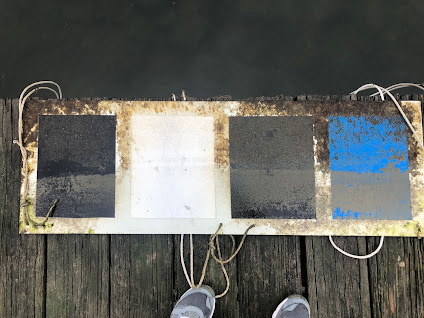
Late Summer I hung 7 test panels with 20 paints from a dock in the Mid-Chesapeake Bay (Deale, MD) as part of a Practical Sailor project. Prior projects have all been seawater. I also applied 50 of these paints to my Corsair F-24. Today I pulled them out for a quick look see. No cleaning, just a check-up.
We don't get much growth in the cold season.You can see it in the non-painted frames. Some are doing amazingly well (the white is actually still that white), and some not very different from untreated areas.
All of the paints are either copper-free or formulated to the new EPA/CA/WA copper leach rate, which most of the good multi-season paints already met (or the copper would not have lasted 3 years--kinda of obvious in retrospect.

What lights do you show when lying to a drogue or sea anchor? You are not anchored. You are not underway in the standard sense, since you cannot maneuver. The answer is RAM. This also includes night diving.
But you can't buy hoistable RAM lights, certainly not any suitable for the limited power supply of a sailboat. So I made my own from LED clearance lights, which are cheap, low draw, and weatherproof. The assembly is >1000-pound tensile strength (tested), so I can rig it tight for rough weather.
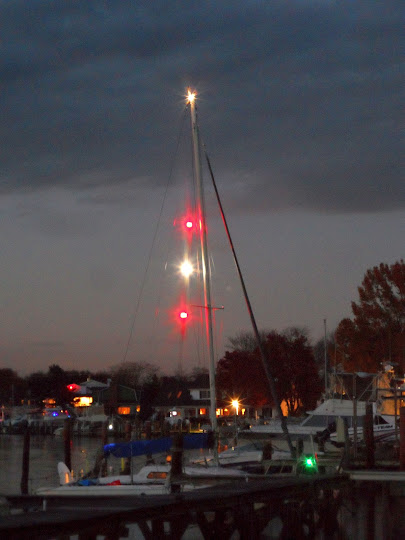
Bright enough? The top light and green light are USCG approved lights. The small white light on my backstay, just above the boom, is another "emergency anchor light" that is clearly not bright enough.
I'm testing them for at least 6 months before I roll it out.
Why would I want RAM lights? I dive at night ocationally. This will keep me seen.
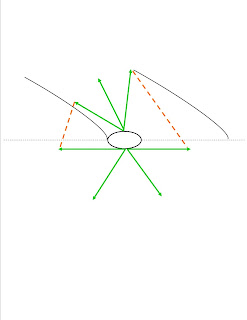
According to Don Jordan, the max load on a JSD (Jordan Series Drogue), during that worst survivable hit, is about the displacement of a monohull, and about 150% of a light trimaran, like the folding Farrier and Corsair trimarans. The problem is, the folding mechanism and floats are not designed to withstand that sort of wracking force. I'm pretty sure far less would pull them right off. I'm pretty sure attaching a JSD or parachute sea anchor to the floats is a failure waiting to happen, and most likely, one you would not survive.
However, the akas (beams) are very strong in compression. That is their design basis. Let's think of this as a truss.
One scenario is anchoring the bridle to the winches (applicable to conventional drogues). The max bridle tension is about 50% displacement, or 3x less than a JSD. A turning block is attached to the beam (sling) or float (reinforced point), and the bridle extends aft from that. Chafe should be minimal if the bridle is polyester. The aft load on the akas is minimized. The bridle is adjustable (angle and length). The compression load on the aka is high, but well below the design load. See notes below.


