Saturday, December 22, 2012

Dehumidifier vs Desicant

Four years ago, in the fall I noticed something I had not seen before; the dreaded black spots, this time on cabin carpeting. Clearly, better humidity control was in order for the cooler season.

A large compressor unit would be a beast on a small boat. Though I have a 30-pint unit at home, the downsides are major:
  • A lot of amps on the shore power cord.
  • A back injury waiting to happen; the unit is huge and awkward.
  • In the way.
  • Loud.
  •  More capacity than I needed.
 
So I looked around and found the Eva-Dry 2200. The no-compressor  principle is elegant, the only moving part being a small fan. The over simplified explanation is that of a thermocouple, but in reverse. Instead of a temperature difference creating a small electric current, the current is forced in the reverse direction through a whole stack of thermocouples, creating a cold plate. Water condenses on the cold plate and runs into a tank.

The size and weight (just a few pounds) are appropriate; when not in use it's easy to swing it into a cabinet for storage, although for day sailing I just put it in the sink to keep it from falling. They are prone to icing in temperatures below about 45F, but deicing by controlling the run cycle with a light timer is simple; 8 hours on at night and 6 hours off during the day. Even in the depths of the winter, the interior of the boat warms above freezing during the day due to solar heating.

I modified the tank by drilling a hole and tapping in a 1/4 NPT x 3/16" ID hose barb. The hose runs to the sink so that it never fills and to prevent freezing and breaking in the winter.

 So far--four years--the unit has just  purred along, removing 2-8 ounces per day, keeping the relative humidity at 45-65% at temperatures from below freezing to 95F. The boat is always dry, the bedding fresh, and interior corrosion issue non-existent.Just like home.
 
 Cold plate frosted

Cold Plate Thawed 

The only real alternative is calcium chloride descant. I did an article about these for Practical Sailor  magazine and still had a few left over. I held a race several years ago, the Eva-Dry in the port cabin and a large absorbant bag on starboard. It wasn't even close. It would take ten 5-pound buckets of CaCl2 to do what this unit will do over 3-4 month winter season.

I also tested a cheaper version from Perfect Home. It lasted about 8 months, just like the reviews said it would.


Tool Box

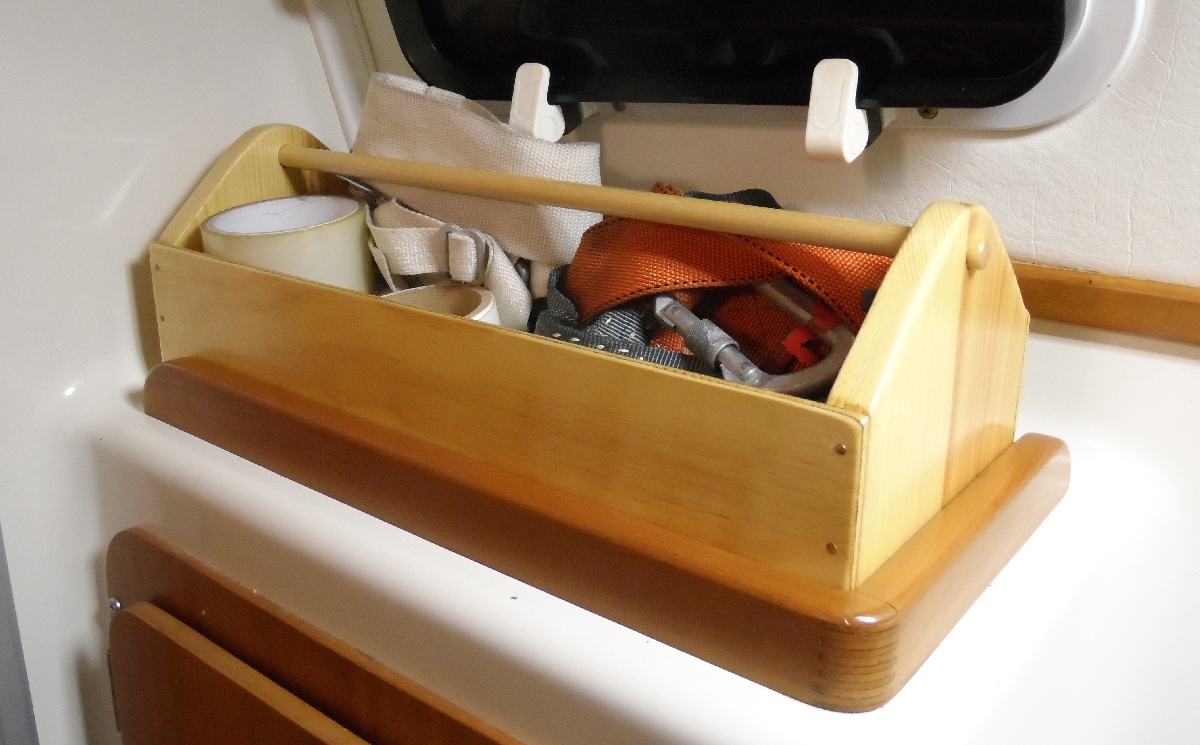
There is a window shelf outside the head that is of no particular use. Sometimes we keep shoes there, but because of the hatch, spray is always a possibility, limiting possible uses; nothing that can't get wet, nothing tall that might block the hatch. I reasoned a light box I can pick up and move will find some purpose and stow some clutter. I like the semi-traditional look; it kind of works on a sailboat that is only semi-traditional. Though sailing is by nature nostalgic, multi-hulls have to keep there distance. No baggy wrinkles here.


A simple scrap lumber project, it is made of 3/4-inch pine to make the ends strong and 1/4-inch ply to keep it light. What will we keep in it? Though I stuffed some harnesses, tape, and cables ties in it for now, we won't really know until we've been cruised with it for a while.

Monday, December 17, 2012

EG vs PG: Conventional Wisdom That is Provably Wrong

rev. 2-4-2013

Some time ago, maybe 30 years ago, winterizing anything with ethylene glycol (EG) became completely unfashionable. Politically incorrect was the new term. Everything had to switch to propylene glycol (PG) because it was lower in toxicity and thus more environmentally friendly. We had always understood that PG must be used in potable water systems because of EG's toxicity and the potential for someone to take a drink before the system was well flushed. Reasonable enough, and we assumed, right or wrong, that people weren't chemistry smart enough to keep these differences straight. But the connection between toxicity to humans and damage to the environment was never correct. It turns out EG and PG are equivalent and it is only metabolic pathways unique to mammals that make EG dangerous to people.


MSDS Information. Producers of products with any hazardous or toxic ingredients must disclose and explain these to commercial users through OSHA's MSDS program that most of us are familiar with. Though there are many products using EG and PG, these 2 sheets present representative data from the same manufacture:

PG MSDS
Ecotoxicity in water (LC50): >5000 mg/l 24 hours [Goldfish]. >10000 mg/l 48 hours [guppy]. >10000 mg/l 48 hours [water flea].
EG MSDS
Ecotoxicity in water (LC50): 41000 mg/l 96 hours [Fish (Trout)]. 46300 mg/l 48 hours [water flea]. 34250 mg/l 96 hours [Fish (bluegill fish)]. 34250 mg/l 72 hours [Fish (Goldfish)].

Though they have expressed the data in different terms, we can readily see that acute toxicity requires percent levels (about 3-4%) of glycols; as a practical matter, the fish will die from low dissolved oxygen before direct glycol toxicity is important. Why the great difference? EG poisons only at relatively high doses in humans, primarily by the action of specific metabolic byproducts; it should be no great surprise that marine organisms deal byproducts and salts differently. This turns out that this is true of all non-mammal organisms. I don't see this as a surprising contrast; zinc is incorporated into many bottom paints because of its high marine toxicity (0.5ppm is quite lethal) and yet the pharmacy sells zinc pills for humans as a dietary supliment. You don't feed chocolate to a dog.


Biodegradability.  No important differences. Both are attacked by bacteria as readily as sugar. In fact, when glycols are used in the air conditioning systems of large buildings it is required practice to either add a biocide or to control the pH at very high levels, which is also lethal to all organisms. Both products exhibit equivalent biological oxygen demand (BOD) is water and both can cause fish kills by this mechanism if discharged in large amounts to small waterways. This is occasionally seen around airports that deice airplanes in the winter. Again, they have found no difference between EG and PG. There is a preference for PG over EG in this case because they spill large amounts--perhaps 5000 to 20000 gallons during a snow event--and for mammal wild life to drink from puddles is plausible.


From the experts: In fact, I could not find any scholarly (fact-based) work that gave a contrasting opinion.

From Risk World (European conference)
"Based upon the limited available data, no general distinction can be made between aquatic toxicities of ethylene and propylene glycol formulations."

From the World Health Organization (WHO)
"Ethylene glycol has generally low toxicity to aquatic organisms. Toxic thresholds for microorganisms are above 1,000 mg/litre. EC50s for growth in microalgae are 6,500 mg/litre or higher. Acute toxicity tests with aquatic invertebrates where a value could be determined show LC50s above 20,000 mg/litre, and those with fish show LC50s above 17,800 mg/litre. An amphibian test showed an LC50 for tadpoles at 17,000 mg/litre. A no observed-effect concentration (NOEC) for chronic tests on daphnids of 8,590 mg/litre (for reproductive endpoints) has been reported. A NOEC following short-term exposure of fish has been reported at 15,380 mg/litre for growth."

From the US EPA, study of airport deicing with EG and PG. Please, read the whole study (447 pages). Marine toxicity is never mentioned in the executive summary because they could make no case against it. They are the same. Neither is good, true enough, but they are the same. They did conclude--correctly based upon my expereince in marine toxicity testing--that the thickeners used in wing deicers are quite toxic because of their effect on gill tissues, but this is not relevant here. Many "non-toxic" cleaners, even common dish soaps such as Palmolive and Dawn, are quite toxic to marine shrimp because of this effect. I've done those studies. They also report that some of the anti-corrosion additives are toxic, it is important to note that as diluted in the formulation for use in a boat (about 3000:1) they contribute very little.
"Table 9-1 summarizes aquatic toxicity data from studies that directly compare ethylene glycol and propylene glycol under the same or similar experimental conditions. In general, the data show that ethylene glycol and propylene glycol exhibit aquatic toxicological effects at concentrations within the same order of magnitude. Although EPA does not use such a system, the U.S. Fish and Wildlife Service Classification System for Acute Exposures defines “relatively harmless” as any chemical with an LC above 1,000 mg/L (3)."


What about the corrosion inhibitors? In PG formulations common inhibitors are dipotasium phosphate and other relatively harmless salts. In engine coolants organic acids and azoles are common. 2-ethylhexanoic acid has an LD 50 for marine organisms of around 100 ppm, but multiply this by 133 for actual use concentrations (LD 50 = 13,000 ppm).
tolyltriazole (TT) has an LD 50 of about 50 ppm, but multiply this by 6000 for actual use rates (LD 50 = 300,000 ppm). Both are biodegradeable and neither is thought to bioaculmulate. So while the inhibitors do contribute to toxicity, small amounts of diluted engine coolants remain far below levels of concern.


What conclusions can we draw from this?
  • EG and PG are simply no different when released into a large body of water.
  • The conventional wisdom regarding EG vs PG marine pollution potential is just plain wrong. Perhaps the PG manufacturers have pushed this. Perhaps folks writing web site copy for good boating practices didn't actually research their writing; those I interviewed commonly related that their information was simply copied from another popular site.
  • Both can be recycled, and this is a good practice whenever possible. But it isn't always possible and the damage of discharging a few gallons is equivalent to tossing an equivalent mass of wood chips in the water.
And a closing point. In all 50 states, all ethylene glycol based engine coolants include a bitterent (Denatonium benzoate) to reduce the probability of accidental ingestion. I've tasted it and can't believe anyone could manage swallowing it now. Suicide perhaps, but not by accident. The notion that antifreeze is "sweet tasting" is simply out-of-date and accidents are historic, not current.


Why does this matter? Because PG is not so good for certain materials of construction and EG is better. Specifically neoprene and nylon don't react so well, and these are common in sanitary and engine systems. That's why.


Update 2-4-2013: Neoprene becomes about 2 times stiffer after 30 days of exposure to 25% PG and about 3 times stiffer with 5% swelling after 3 months exposure. Identical EG exposure causes no change. However, stiffness and size return to normal within 48 hours when soaked in fresh water. Any lasting harm? Not certain.
 

Friday, December 14, 2012

Wieght

It's often said that boats are sold by the pound; epoxy, glass, aluminum, stainless, and the labor to put it all together. Multihulls run higher than monohulls because the keel is cheap in relation, they don't need 2 of so many things, and because the construction is less convoluted. I'll stick to multihulls, since it's what I know.

For the sake of argument, let's say you can buy a Gemini Legacy for $275,000/9,400 pounds, or about $30/pound. A performance boat like the Stiletto 27--if one could be bought new-- would be about $80,000/1,250 pounds, or about $65/pound. Gunboats run about $80/pound. Ouch. Used cars, on the other hand, run perhaps $2-$4/pound; though they don't float so well, they do fly to windward.

What would we pay for a lighter boat with better performance, strength being the same? Would we pay $40/pound? Most of us bought used--I paid about $13/pound--but I'd spend a little for speed, maybe $20/pound. By that logic, we would pay ~ $30/pound for every bit we could save on our current boat, whether from taking out the trash. Hauling less fuel when practical, or pumping the holding tank more often. We would evaluate every project, looking for places to swap composites for steel and Spectra for stainless steel cable.


Anchors. A 35-pound new-age anchor seem to be the thing if you want to stay in one place. Certainly the second anchor should be a Fortress? A $239 Fortress F-16 compares with a Danforth 16 for $89, but at 6 pounds more. $25/pound for the savings. And of course the Fortress is much easier to handle, so very OK; doctor bills for my back add up.

Chain. Proof coil or BBB vs. G4. For a given rating, G4 is cheaper. Perhaps it is less durable in the very long run, but given the value we place on weight savings, an easy call.

Chain. G4 vs rope. Again, rope is lighter and cheaper. But rope doesn't feed through the windlass as well and cuts are possible. I chose 100 feet of chain backed by rope as a compromise. In the shallow waters of the Chesapeake that puts me on all-chain 98 % of the time. All-chain for a multihull is hard to defend, and I would rather have some rope for shock absorption in extreme conditions. A dollar per pound foolish compromise? The windlass made the decision for me.

Lifelines. Stainless is about 3 times heavier and 70% more expensive than Amsteel, even when the Amsteel is sized to be 3 times stronger.  Only $12/pound for the savings and a $120 savings for my boat. Durability seems good, as the first reports trickle in. I've seen corroded stainless snap without warning. I'm going with 3/16-inch Amsteel in a few years. Should be good for a 0.02 knot improvement (yes, I calculated that figure).

Locker stuff. Always a hard call. It's always hard to say which spares and what toys will save the day, but at $20/pound to haul it around we need to be circumspect. Certainly seasonal items such as quilts and wet suits can go home for dry storage. How much is the labor? Heck, they need cleaned or serviced anyway.

Fuel vent filters. A 1-pound vent filter eliminates the need to keep a full tank to reduce breathing, perhaps reducing by 100-150 pounds the amount of fuel that must be carried day sailing and on short trips. Only about $1/pound. A bargain. They also reduce evaporative fuel loss, making them free in the long run.

Down-sizing ropes. So long as the stretch and handling characteristics of the high-modulus lines are suitable, makes sense even for the non-racer. But sometimes the handling and stretch characteristics are wrong--I like some stretch in the traveler and topping lift. I like lines with some size, nothing below 3/8-inch. I put in a free Spectra traveler line and I don't like it better. I have Spectra genoa sheets an they are fantastic. I would decide based upon function, not weight.

Leaks. Are any of the crash tanks holding water? A hundred pounds of water would create a $3000 loss in value, one more reason to get it fixed.

Aluminum or composite propane tanks. A good weight savings (~ $15/pound) and non-corroding. I'll go that way if mine get shabby, but I keep them painted for now.

Holding tank. Pumping more often couldn't hurt, but I'm lazy. A Raritan Lectrasan might make sense for some folks--it weighs about the same as 10 gallons of water when full--but that is about what I average in my tank and I prefer the practice of shore-side pumping-outs. Additionally, my home marina and local sailing area is a no-discharge-zone. No weight savings for smaller boats or smaller families, but worth considering for larger boats.

Freshwater tank. There's really no reason for it to be full all of the time. But I never know when I'm going to head out for a day or two.

Batteries. There may be some real opportunity in the near future, when laptop tech (lithium) approaches lead/acid for economy. We'll need to look at pounds/amp-hour and cycles.

Projects. Yep, I've added a few pounds here and there. But I use aluminum and light ply/composite constructions where ever practical, instead of stainless or solid wood or glass. The solar panel mount was aluminum and minimal. With the exception of the sea chest (composites would have been all wrong there) most of my shelf and box projects are 1/4-inch ply, glass and epoxy. I use fabric in place of wood where possible. Lashings and stropes save ounces.

____

So what's on my lighten-up list? A Mast-Mate mast ladder; haven't used it in years, will do a quick inspection climb and take it home. I keep accenders on-board anyway, so in an emergency they will serve. My bike rack can stay at home with the bike. I've got some spare blocks that could be at home. I've got a little gut to lose before ice climbing season. What stays? Any part I've used before: sheer pins, spare props, oar locks, cabinet catches, engine parts, electrical stuff, and some bits of rope (2 extra rodes and some small stuff). Food and beer.

Weight saving projects? There is certainly a noticeable difference, loaded for cruising vs. empty tanks and no crew. I remember the sea trial on the day I sold my Stiletto; emptied of superfluous stuff and with a clean bottom she flew, reaching at well over wind speed, into the high teens under working sail alone. I wanted to keep her.

Saturday, November 24, 2012

The Need for Everyday Jacklines

It was a little breezy today--sustained at 20 knots with gusts to 30 knots. The water and air were cool, both perhaps 45F. A beautiful day for some brisk solo sailing.

I started out with full sail, but within 15 minutes a reef seemed smart. 30 minutes later a second reef seemed smart, along with a little jib rolled in as well. No worries; even though I reef at the mast, the jack lines are always rigged and the auto helm was holding course nicely. Just a time to be causious. The bow was going through as many waves as over them and the motion was a bit crazy, but that's what fall sailing is about.

I noticed I had left the boat hook bouncing around on the deck; I never tie it down and it has bounced there for over 2000 miles. But it was getting washed around more than normal. It had been tossed from the tramp up on to the seats in front of the salon. Its bent, but its a friend. But I have a spare on board, found on along beach somewhere.

I noticed the spinnaker bridle had somehow worked loose--last time it was used a guest secured it, or rather didn't--and there was some question in my mind as to whether it could get under the boat and into the prop or rudders later. I figured I needed to go get it. Except that 45F water is washing ankle-deep across the tramp every 10 seconds, everything is soaked with sheets of spray, right up to the dodger, the tramp is a wide expanse free of handholds, and I was sailing alone. Bugger.

And this is why you keep jacklines rigged EVERY DAY. No problem, I clipped in, walked along the side, used the jackline in one hand to ease my way across to the leeward side, and clipped in with the short leg. After securing the lines and grabbing the wayward boat hook I hauled myself to windward with the tether and retreated to the cockpit.

I tacked and broad reached home, faster, with less motion... and no concerns.

Gasoline and Fuel Tank Vent Filters

Rev. 11-24-2012. First posted Spring 2012 as part of a longer blog entry. For my fellow PDQ sailors, Dog House and Shoal Survivor have been testing these since spring with no problems. I re-posted it here with a few revisions because it was buried in a longer post and because the LONG version will be published next month.

Rev. 5-3-2021. A few more updates. 

So what do the new vent filters look like?


This filter housing survived 7 years of testing before the boat was sold.   It is mounted to a FRP mounting plate, which was screwed and epoxy to a cored bulkhead. It was installed in the vent line, between the Raycor Lifeguard air/fuel separator and the through-hull. This is a modified Vetus No-Smell housing. Holding 500 ml of adsorbent, it is the correct EPA-rated size for a 27 gallon tank,  is fuel rated, easy to switch adsorbents, and I had it.

I tested pelletized carbon, silica gel, alumina, and mixed beds. The winner, in terms of water absorption and evaporation was silica gel. Conventional wisdom suggests carbon should work better for vapor control, but because carbon cannot function in high humidity environments, and because much of the vapor is ethanol (which is more water-like) and not gasoline, silica gel performed better in all parameters. It is also easily regeneratable, which carbon is not.


Installed. The vent leads up from the fuel tank, through the Raycor Life Guard, through the Vetus No-Smell (several adsorbant types tested) and down to the existing through-hull. I had to manufacture a new perforated metal retaining plate for the Vetus unit; this allowed testing with a variety of adsorbents.
The H2OUT filter is even simpler. Refilling is a simple matter of loosening a band.


A factory installation, in a 2012 pontoon boat.  Instead of mounting the canister in a high loop, they protect it with a filling cut-off valve and sensor in the fill line (so that auto-stop filling pumps will work), an anti-surge valve on the tank, and a p-trap on the through-hull. These canisters are intended to last the life of the boat. All Attwood equipment.


This may seem a bit over engineered. I don't think so, not if maintenance becomes less, fuel related problems go away, starting is easier, and a material amount of gasoline is conserved (reduced evaporation losses) to pay for the project. Green, cheap, and lazy, over the longer term. That's just smart.

Try this link, if you would like a better summary of both the new rules and the safety rational behind gasoline fuels system requirements.

The full article is in the January 2013 Practical Sailor Magazine.

  --------

Notes, 11-24-2012: We tested granular carbon in Vetus housing in the spring of 2012, but changed to a silica gel/alumina blend after a few months. The carbon was a complete failure, became saturated with water to the point of condensation and dripping.Perhaps carbon will work better in other climates, but not on the Chesapeake in the spring.

We have had 2 test units (H2OUT and Vetus) in service on 27 gallon gasoline tanks since spring 2010; they are both doing well and have not saturated. Humidity readings inside the tank are well below saturation and the color indicators have not changed at all, suggesting that several years of service can be expected.


4-15-2013: After 1-year of service the silica gel has saturated no further, humidity levels on the tank side remain stable (35-45%), and condensation is a thing of the past. A service life for the silica gel of  > 5 years seems certain.

12-14-2013:  Still going strong. 

8-10-2016: Gel finally changed color and had to be regenerated by heating. 15 minutes on low on the propane grill in a pan did the job.

3-10-2018: Still going strong.

Monday, November 19, 2012

Spice Rack


 PDQ 32s factory equipped with Dometic dorm-style refrigerators are also equipped with a completely useless drawer to the right of the fridge. The openings are too small for medium adult hands to fully enter, severely limiting the size of objects that can be stored. Even spice bottles are too big, except for the smallest sizes. The drawer was deep--18 inches but only pulling out 8 inches--so any thing that did enter would slide to that back and never be seen again;  remember, the openings won't admit a hand or wrist so you can't reach the back, even with a fork held by fingertip. The whole business is built of 1/2-inch thick lumber, reducing the 7 1/2-inch cut-out in the fiberglass to a mere 2 1/2-inch inside shelf width. Just pitiful. Down low, below the drawer, is a cubby hole that is handy enough for small items, in our case disposable table wear; I wanted to keep that, but I didn't want more cubby holes.

Though I could have scratch-built a replacement, matching the wood would be a challenge and I liked the outside look and fit. Instead, I took a few measurements and reasoned that it could be gutted, fitted with an improved drawer that would make a very usable spice rack, and that I could accomplish this in an evening.

The entire cabinet assembly is easily unscrewed and taken home, so that all work can be done in the shop. That helps. The drawer facing pops off easily with a few carefully applied hammer blows and a little wiggling with a wood chisel. Likewise, the stops in the back (to preventing the drawer from coming all the way out when pulled) popped right off. Both were easily cleaned of glue residue with a chisel.

I removed both sides of the drawer, leaving the top, bottom, front, and back untouched, with careful plunge cuts with a circular saw and some trimming with a saber saw. The sides are still attached to the shelves with a few spots of glue, but were pried out with very little effort. Likewise, without side support, the internal shelves were easily removed and discarded. The new plan called for only an upper and lower rather than the original overcrowded 3 shelf arrangement.

The new shelf is not centered; spice bottles come in 2 basic heights, so I made room accordingly.

Dig the sawdust reflected in the flash (click to enlarge)
I did not replace the original sides. The original drawer had ~ 5/8-inch clearance on each side, so I simply screwed new 1/4-inch birch ply sides to the outside, increasing the internal width of the shelf by 1-inch to 3 1/2 inches This is critical, as it makes the difference between a single row of bottles and a double row. I made the fiddles on the shelf a bit over 1/2 the height of the bottles to insure they cannot jump out in wild conditions, though they will simply end up in the large locker under the fridge if they do. With the larger cut-outs my hands fit easily. The corners of the cut-outs were made with hole saw and press (no center bit) and connected with a circular saw and saber saw and trimmed with a hand grinder. All of the screws are countersunk to avoid catching.

The original drawer did not pull out as far as it could; measurement showed that it could pull about 2 1/2 inches further without interference, so I repositioned the stops. This was easily done by extending the new sides back an additional 2 1/2" + 3/4" = 3 1/4" beyond the back of the drawer and attaching 3/4-inch cleats. Free additional opening space and less is lost in the depths.

Easy...ish and built from scraps. $4.65 for screws. I could have built it with hidden fasteners, but I liked the idea of being able to open it and change it, if I like. About 4 hours, but 3 of those were spend measuring an figuring. I could do a second in an hour. Isn't that typical?

More space, more function, no change in weight, and my wife is appreciative. I find the last of these most rewarding.

Saturday, November 17, 2012

Small World

A crisp fall day. Relatives in town, but off visiting the National Holocost Museum for the morning. I was sailing just a few days ago and will again in a few days. I'm working a small project I want to install, but it needs a few more coats of varnish. A perfect opportunity for a short bouldering work-out at the local crag, Carderock.

I walked the base of the cliff, scanning for familiar faces; often we come without having made arrangements with friends and simply meet up. A good way to meet new faces, too. Mostly, that's how climbers meet and how climbing partnerships form.

"You look like you've been here before"a stranger bouldering up the crag called. I noticed he had experienced (old) shoes and callused hands, suggesting he was an old hand at the climbing thing. The way he moved suggested to me that like me, he knows what he's doing but has been away from it for a while. Old shoes that are mostly worn out suggest that too.

"Yes, for 30 years anyway. Can I help?"

"No, just looking around. A caught a ride on a top rope with some guys over that way. Fun. Nice place."

"Where are you from?"

"Annapolis."

Sounds like more of a place for sailing than climbing." Annapolis is hopelessly flat.

"Actually, yes. I teach sailing."

The conversation went on a bit, me relating that I had a boat in Deale, one of a string of boats. Some stuff about sailing. I said goodby and wandered to the far end of the cliff to boulder alone. But about 100 feet away I turned around and decide to return to the stranger, to be a bit more sociable to our visitor.

We talked a bit more. He coached J-80 sailing for J-World. We talked about fast boats, planning on J-boats, and speed on the Stiletto 27 and capsizes of the new AC 72. I mentioned that I'd slowed down and bought a PDQ 32.

"I know a couple who has one of those, out cruising."

I thought I knew the answer but asked anyway; "Oh, really? Who?"

"Zero-to-Cruising. I follow their blog."

"Cool! Me too. I met them once, in Cape May, and we trade emails now and then. Good folks."

"Would you believe me if I told you that I taught their "learn-to-sail" class in Miami?'

"Yup, I'd find that easy to believe!"

We chattered on for a while. I pointed out a few bouldering spots, but in no way gave any demonstration of prowess; I was wearing a heavy knee brace and was having a high gravity day. We talked about a few sailing adventures. I gave him dirrection to a few local crags he'd heard of within the local area--Easter Egg Rocks, GreatFalls--and we parted ways.

Small world.

Saturday, November 10, 2012

Salon Table Access

While the salon table provides worthwhile storage volume, it has always been awkward to access. Something is always on the table; dining accessories, snacks and general stuff the forward end, and a DVD player is in permanent residence on the aft end. BTW, the flat screen hinges up and the Bose computer speakers speakers can really rock the boat.


I replaced the aft access lid with a hinged section. Just pine from retired shelving unit and a cast-off piano hinge. The finger holes for lifting were drilled about 1/2-inch deep with a forstner bit, which leaves a smooth, flat bottomed hole. If we like the functionality I may either stain it to match or slice the original board at the appropriate spot. So far, we like it; we can actually use these bins. Case in point: installing this project I found a book-on-disk that had been borrowed from the public library and long since paid for as lost.


Later I added a drop-in DVD holder. Very handy.


As for the hinged flat screen and the forward section, those are described elsewhere, but they look like this...


and like this....


Now, to listen to that book-on-disk....

Saturday, November 3, 2012

Comunication

For modern mariners, the foundation tool is VHF, perhaps the most dependable means over distances of less than 20 miles. Good for bridge openings, talking to marinas, and summoning help. For communicating with friends, it's been largely replaced with cell phones and internet services, even though those can be less than reliable even in coastal areas. Off-shore we transition to SSB and sat phones.

But there are other ways. These messengers were used by Bernard Moitessier during the first round-the-world singlehanded race, describe very well in A Voyage for Madmen.

Very traditional, rather like his yacht. Dependable and thrifty?

For express service, he chose a multihull design.

 Most of us would judge him a bit mad by this point in the race, but for him, this seemed to be his "normal." He was simply well adapted to life alone, at sea, and less so for life with people ashore.