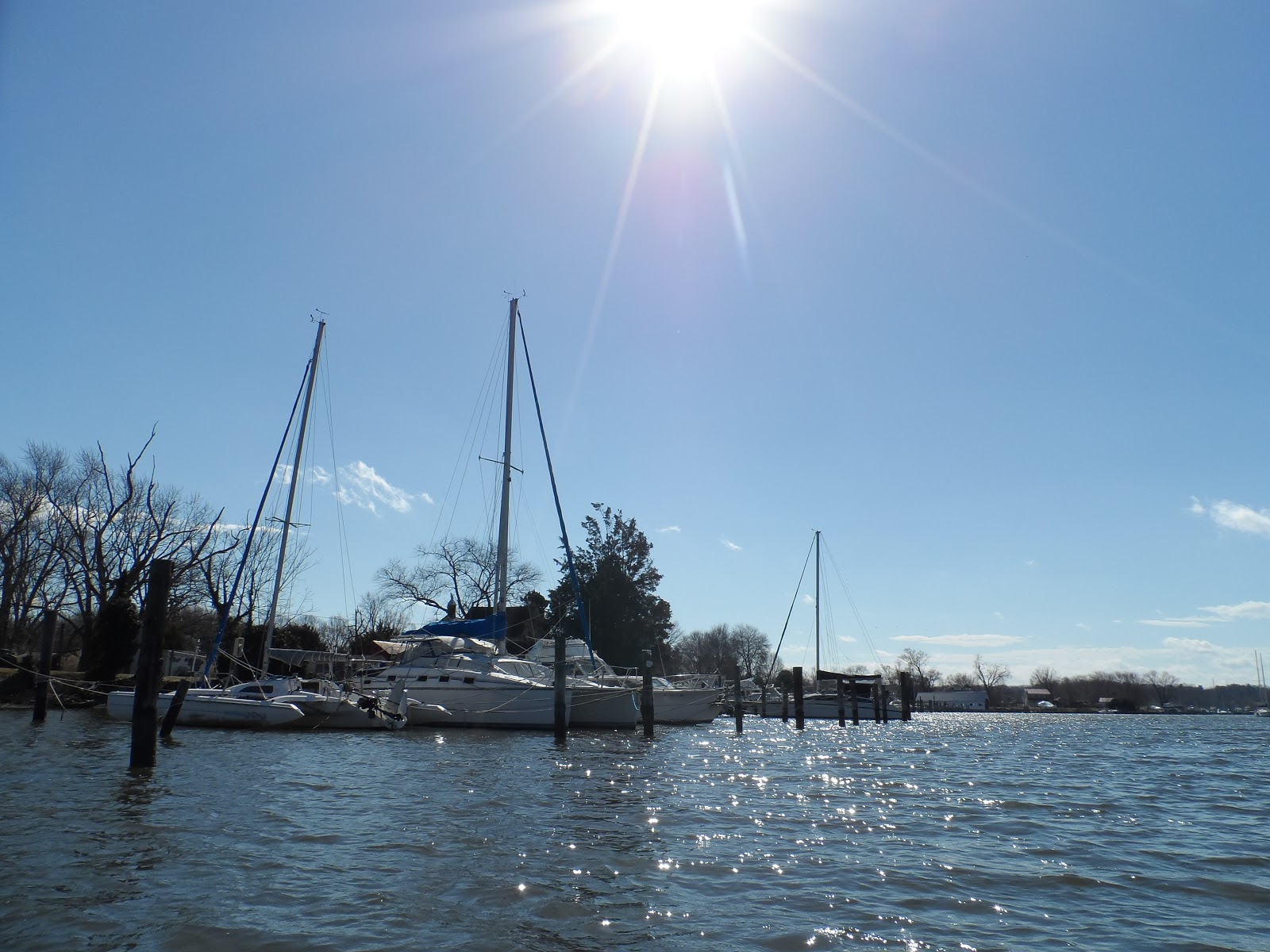
In the process of making room for more boat stuff, I came across these, which should go.
Used, but functional. In my opinion, every PDQ owner should carry at least one spare, if not two. Once in a while you will wind up a lift line or find a crab pot. It's a 5-minute change... if you have a spare. I always carried a spare.
They're ~ $70 on e-bay. How's about $50 for all three, plus whatever shipping costs (unless you pick them up, either Vienna, VA, or Deale, MD.
Pages
- Home
- Introduction to Sail Delmarva
- Site Map
- Anti-Chafe Gear
- Marine Winterizing Primer
- Man-Overboard Recovery and Climbing Gear
- Holding Tank Odors vs. Carbon Vent Filters
- My Other Blog (Chesapeake Gunkholing and Kayaks)
- The Purpose of Work
- Diesel and Biocides
- Practical Sailor Magazine
- Good Old Boat Magazine
- The Bookstore
Monday, August 27, 2018
Spare Yamaha 9.9 High Thrust Props for Sale
Labels: Guide Revisions, PDQ Tips
Repairs and Maintanance
Tuesday, August 21, 2018
Depth of Discharge vs. Battery Life
It's a cruiser mantra that lead acid batteries should never be taken below 50% state of charge. There is some pretty convincing math on this for batteries that are cycled daily,including full-time cruisers and off-grid power systems. On the other hand, golf carts go lower than that every day.
And for the rest of us, who cruise weekends and a few weeks now and then, we don't rack up that many cycles, perhaps 100 in 5 years and 200 in 10 years. Northern holiday cruisers are even more challenged to rack up high cycles, with the boat out of the water half the year.
I need to look into this farther.
And for the rest of us, who cruise weekends and a few weeks now and then, we don't rack up that many cycles, perhaps 100 in 5 years and 200 in 10 years. Northern holiday cruisers are even more challenged to rack up high cycles, with the boat out of the water half the year.
Even using shallow cycle designs, which we are not, we'd be hard pressed to hit the cycle limit within 10 years if we took them to 60 %, and we would just hit it in 5 years at 80% discharge. With standard deep cycle batteries, we could discharge to 80% far more times than we will ever spend the night on the hook. The batteries will die of corrosion, failure to recharge, or failure to water first.
This has been my experience. I use relatively small battery banks and discharge past 50% regularly. I do recharge as soon as possible and I do check the water. I typically have gotten 7 years, whether cruising frequently or not, before I loose enough capacity I replace them (never complete failure, such as a shorted cell).

Why what some would consider an undersized bank? Because on a multihull, weight is worth money. My boat cost $20/pound and I feel every pound saved is worth $20 in performance. Otherwise, I would have purchased a slower boat. Carrying an extra battery (75 pounds) costs $1500 in weight penalty.First, I don't believe adding a battery would extend the battery life in proportion to the added purchase cost; they would last perhaps 15% longer and cost 25-50% more to replace. The $1500 weight penalty stands. The only upside is additional reserve capacity, which isn't worth $1500 to me.
(That's 25 degrees C, not 250C like it says)
I've had enough different boats to understand that for each boat, my answers to these questions would have been
different.
- How big is the bank? A single group 24 battery is minutes to change, but a big bank of traction batteries is a project.
- How critical is power failure? An outboard can be pull-started, a big diesel is a problem.
- What charging sources are available? How many days between full charging?
- How often is the boat anchored-out? Are we talking thousands of cycles or hundreds during the life of the battery?
I need to look into this farther.
Labels: Guide Revisions, PDQ Tips
Repairs and Maintanance
Saturday, August 11, 2018
Dual Rod Holder From Scraps
Or rather from a stern rail motor mount that the the PO liked but I had removed. In my mind, either the engine should be able to stay on the dingy or...
It's primary purpose is to hold my 2 mini-outriggers (2 x 6' outriggers give me an effective beam of 26 feet, easily trailing 3-4 lines without tangles) while not trolling. They can't left in place during docking, and placing them in the outboard rod holds inhibits easy boarding and blocks the holders for other uses. I find rod holders handy for other things as well--boat hooks, walking sticks, gaffs, oars--so i can never have too many.
I dislike commercial holders since they only grip the rail without twisting if tightened so much they scar the rail. This never will, since it uses an up-right for bracing.
Construction was simple enough. I had to slot the back to accommodate a brace. The 2" SCH 40 pipe is attached with counter sunk #10 machine screws. In the background are a pair of kayaks lashed to the top of the davits, the most convenient storage space.
- The davits or hoist is weak. Upgrade.
- The engine is too damn big.
- The dingy moves too much, in which case it should be triced-up.
- The dingy is vulnerable in rough weather. Not the case on most catamarans, since the davits are forward of the transoms.
It's primary purpose is to hold my 2 mini-outriggers (2 x 6' outriggers give me an effective beam of 26 feet, easily trailing 3-4 lines without tangles) while not trolling. They can't left in place during docking, and placing them in the outboard rod holds inhibits easy boarding and blocks the holders for other uses. I find rod holders handy for other things as well--boat hooks, walking sticks, gaffs, oars--so i can never have too many.
I dislike commercial holders since they only grip the rail without twisting if tightened so much they scar the rail. This never will, since it uses an up-right for bracing.
Construction was simple enough. I had to slot the back to accommodate a brace. The 2" SCH 40 pipe is attached with counter sunk #10 machine screws. In the background are a pair of kayaks lashed to the top of the davits, the most convenient storage space.
The lures are home-made too.
Labels: Guide Revisions, PDQ Tips
Fishing,
Repairs and Maintanance
Thursday, August 9, 2018
Sun Protection
The sun is a real bugger in the summer. I realize I was spoiled by the big hard top on the PDQ, now that I'm baking in the sun once again.
Earlier this week, after enjoying a nice sail, I decided to anchor for a bit in the falling breeze, to eat lunch and eventually do some paddling along the coast. The first thing I did was rig an awning, which was a life saver.
I need to fine-tune the pitch, but this nylon tarp keeps the sun off. Notice some chipping of the paint.
I made it up 10 months ago out of a blue nylon tarp I had. Itis attached to the mast and topping lift, with straps around the shrouds and posts fitted to the stern pulpit. I didn't set the back corners correctly for this image (I forgot where they went), but you get the idea. The white paint is nothing more than a single coat of Behr from Home Depot, casually slapped on; I learned from another boat that white really drops the temperature.
And then there are light air sails, like this furling laminate reacher, that have no UV cover. We don't leave it up, partially for this reason, and partially because we don't use it most days. But it would be nice to leave it up, if only it had some protection....
You won't see me sewing a UV strip on it. Stitching a Mylar sail is like adding a tear-here perforation.
The water is wonderful, but the air is steamy.
Earlier this week, after enjoying a nice sail, I decided to anchor for a bit in the falling breeze, to eat lunch and eventually do some paddling along the coast. The first thing I did was rig an awning, which was a life saver.
I need to fine-tune the pitch, but this nylon tarp keeps the sun off. Notice some chipping of the paint.
I made it up 10 months ago out of a blue nylon tarp I had. Itis attached to the mast and topping lift, with straps around the shrouds and posts fitted to the stern pulpit. I didn't set the back corners correctly for this image (I forgot where they went), but you get the idea. The white paint is nothing more than a single coat of Behr from Home Depot, casually slapped on; I learned from another boat that white really drops the temperature.
Which brings us to sails. Every self-respecting furling genoa has a sacrificial UV strip, usually Pacific Blue Sunbrella (which the sailmakers call "everybody blue"). It lasts until the stitching fails, generally about 5-8 years. You can either restitch it for another 5 years, or have it replaced for $400-$800. It's heavy but durable. Some folks use sail cloth or self-adhesive Insignia Cloth from Bainbridge; a waste if you ask me, since they only last 3-4 years.
You won't see me sewing a UV strip on it. Stitching a Mylar sail is like adding a tear-here perforation.
This jib suffered a 5-foot tear right along the stitch line. The cover was post-factory and the sailmaker that added the cover was an idiot (you need to insert a special scrim or layer of polyester before stitching Mylar).
We also know that paint can stick to sails. This is for advertising, not UV (mostly--it must help), but it does last a year.
Can paint provide a serviceable, light, and economical alternative to Sunbrella UV covers? Maybe it won't last as long, but on an older sail, does that really matter? Perhaps the $600 you save is more wisely earmarked for a new sail in 4-5 years.
I'm lining up some test paints. I think you will see a paint UV cover on my reacher in a few months. We don't leave it up much, so I'm sure it will be enough. I doubt the UV cover will ever fail on our Mylar genoa--the sail will explode first. Would I use paint in place of Sunbella on a new polyester genoa? Probably not, but perhaps for an old dog. On a Mylar jib? Yes, I'm thinking it might be the better value, if I can find the right paint. I already know that stitching a cover onto Mylar is questionable at best.
Labels: Guide Revisions, PDQ Tips
F-24 Tips,
sails and canvas
Saturday, July 28, 2018
A Coupler That Can Feed Through Fairleeds...
... or rather that is what I need to find. I would like to couple my furler line to webbing, but instead of a swivel as illustrated below, I want a quick disconnect.
From the bow of a sport boat at a boat show.
It needs to glide through fairleads, with WLL of about 100 pounds. I'm not adverse to machining something, but if I could find a design that would be better. Perhaps I could make something from 3/8-inch alloy rod where the two haves screw together. Not super quick.
Better ideas?
Thursday, July 26, 2018
Dyneema Anchor Bridle
"Bridles are made from nylon, right, to absorb impact?" Well, yes and no.
If the rode is all-chain, yes, at least 30 feet of nylon is required to take the sting out of waves and wind gusts. Since multi-hulls use bridles to reducing yawing anyway, a nylon bridle is an elegant solution.
On the other hand, if the rode is nylon, it's easy to have too much stretch, to the point where fore-aft surging is actually increased, This leads to more impact and more yawing, since there is slack in the system. Logically, there is an optimum amount of spring in the system for a given yacht mass and sea state. A chain leader is another non-stretch element. By tuning the amount of chain, other non-stretch leader, and non-stretch bridle, motion can be minimized. 30-40 feet of nylon is good in relatively sheltered areas, and 80-120 feet is the most that is advisable. As much 300 feet is used with sea anchors in storms, but the wave conditions are unlike anything you would anchor in.
The other concern is stretch. A nylon bridle distorts when the load comes more to one side. The more it distorts, the more the boat yaws, and the farther it distorts. With a multi-hull bridle this may increase yawing 10-20 degrees. With a narrow monohull bridle, it may distort to where there is no bridle effect at all. For this reason, non-stretch bridles are better with drogues and sea anchors.
"How about polyester? It is low stretch also?" In fact, I used a polyester double braid bridle on my 34-foot PDQ when I had a nylon rode. It worked very well and was easy to handle. Dyneema works on the F-24 because it is left rigged all the time and Dyneema presents less drag through the waves and weight. It is also very UV resistant and has the best strength/dollar ratio available. It fits the small bow eyes and does not fatigue. Because the rode is recovered from the center hull using the main rode, I never handle it under load. But polyester was better on the PDQ and any application where it might be handled under load, whether by hand or winch.
Always something new.
If the rode is all-chain, yes, at least 30 feet of nylon is required to take the sting out of waves and wind gusts. Since multi-hulls use bridles to reducing yawing anyway, a nylon bridle is an elegant solution.
I usually attach the bridle with a prusik loop from a Dyneema climbing sling, but a knot is fast in light winds and I had misplaced the loop. A knot weakens the line and jams if the wind is over 20 knots (25 knots for a figure 8 knot), so I don't recommend it.
On the other hand, if the rode is nylon, it's easy to have too much stretch, to the point where fore-aft surging is actually increased, This leads to more impact and more yawing, since there is slack in the system. Logically, there is an optimum amount of spring in the system for a given yacht mass and sea state. A chain leader is another non-stretch element. By tuning the amount of chain, other non-stretch leader, and non-stretch bridle, motion can be minimized. 30-40 feet of nylon is good in relatively sheltered areas, and 80-120 feet is the most that is advisable. As much 300 feet is used with sea anchors in storms, but the wave conditions are unlike anything you would anchor in.
The other concern is stretch. A nylon bridle distorts when the load comes more to one side. The more it distorts, the more the boat yaws, and the farther it distorts. With a multi-hull bridle this may increase yawing 10-20 degrees. With a narrow monohull bridle, it may distort to where there is no bridle effect at all. For this reason, non-stretch bridles are better with drogues and sea anchors.
"How about polyester? It is low stretch also?" In fact, I used a polyester double braid bridle on my 34-foot PDQ when I had a nylon rode. It worked very well and was easy to handle. Dyneema works on the F-24 because it is left rigged all the time and Dyneema presents less drag through the waves and weight. It is also very UV resistant and has the best strength/dollar ratio available. It fits the small bow eyes and does not fatigue. Because the rode is recovered from the center hull using the main rode, I never handle it under load. But polyester was better on the PDQ and any application where it might be handled under load, whether by hand or winch.
Always something new.
Thursday, July 12, 2018
Skeg Repair
A nice feature of the Wilderness Systems Aspire kayaks is a retractable skeg. Deployed, the boat tracks arrow straight, but retracted it turns like a (sluggish) white water boat. However, the skeg is somewhat fragile, prone to breaking when dragged on-deck or across rocks when not retracted, and we do tend to forget.
A Factory Replacement for $22.00 would have been one option, and I might have done that had the factory gotten back to me right away, but they took over a week, and by that time I was done.
Additionally, I've been playing with flexible repairs using polyurethane sealant reinforced with Sunbrella canvas. I used this method on the mini-dodger, I've used it for household repairs, and I used it here. The advantage is a skeg that will give when striking a rock, like a rubber flipper, which makes a lot of sense to me.
Locktite PL S30 has proven to make permanent bonds to many plastics, including polyethylene and ABS (what the skeg is made off) so long as the surface is coarse sanded and flame treated. Flame treating is the process of waving a propane torch over the plastic just enough to cause a slight blush, which changes the surface chemistry.
After that, just laminate as though it was epoxy and fiberglass, alternating layers until the desired thickness is reached. I used 3 layers of cloth; larger pices on the sides and a thicker filler in the center. I trimmed to to size with a razor knife and a grinder. The result is something like a tire side wall, depending on the thickness.
A Factory Replacement for $22.00 would have been one option, and I might have done that had the factory gotten back to me right away, but they took over a week, and by that time I was done.
Additionally, I've been playing with flexible repairs using polyurethane sealant reinforced with Sunbrella canvas. I used this method on the mini-dodger, I've used it for household repairs, and I used it here. The advantage is a skeg that will give when striking a rock, like a rubber flipper, which makes a lot of sense to me.
Placing Sunbrella over the crack, after coating with polyurethane sealant. I will add 2 more layers, with sealant between them and over the top.
Locktite PL S30 has proven to make permanent bonds to many plastics, including polyethylene and ABS (what the skeg is made off) so long as the surface is coarse sanded and flame treated. Flame treating is the process of waving a propane torch over the plastic just enough to cause a slight blush, which changes the surface chemistry.
The back corner was broken off. Now there is a nice flexible tip that can't break. It looks a little lump, but the feel and stiffness is like a mud flap.
After that, just laminate as though it was epoxy and fiberglass, alternating layers until the desired thickness is reached. I used 3 layers of cloth; larger pices on the sides and a thicker filler in the center. I trimmed to to size with a razor knife and a grinder. The result is something like a tire side wall, depending on the thickness.
I wish I'd taken before pictures. I dive into projects too fast sometimes.
I've also used this method to repair leaky ponds, cat carriers, and plastic tanks. What are other good applications for a tough, flexible lamination?
Saturday, June 23, 2018
Afordable Slips in Deale, MD
Update: The 18' slip used by the PDQ in the foreground is now open. She moved on to Rhode Island leaving a big hole in the water that needs filled.
Still plenty of wide slips, suitable for boats up to 16'-18' beam for fraction of the going rate. Facilities are minimal, but water and charging power are included, the marina has proven safe through 25 years of storms (zero dock damage), and the water is just as wet.
Why so cheap? No facilities and the water is not deep enough for a monohull's keel.
Why the spiff? I've been there for 25 years and nothing has gone wrong. That's pretty good.
Phipps Marina
Calvin Phipps
615 Phipps Road
Deale, MD 20751
410-867-0299
Still plenty of wide slips, suitable for boats up to 16'-18' beam for fraction of the going rate. Facilities are minimal, but water and charging power are included, the marina has proven safe through 25 years of storms (zero dock damage), and the water is just as wet.
Why so cheap? No facilities and the water is not deep enough for a monohull's keel.
My new F-24 in the foreground, PDQ 32/34 Shoal Survivor next, and PDQ 36 Grizabella in the distance.
Why the spiff? I've been there for 25 years and nothing has gone wrong. That's pretty good.
Phipps Marina
Calvin Phipps
615 Phipps Road
Deale, MD 20751
410-867-0299
Monday, June 18, 2018
The Parts of a Catamaran
We can use the made-up English names, or we can call them what the inventors did. Of course, most of the English names for parts are bastardizations of European words and older version of the languages.
Subscribe to:
Posts (Atom)