Saturday, June 6, 2009

Carbon fiber, tapered battens, and a slack leach.

rev. 2-6-2010

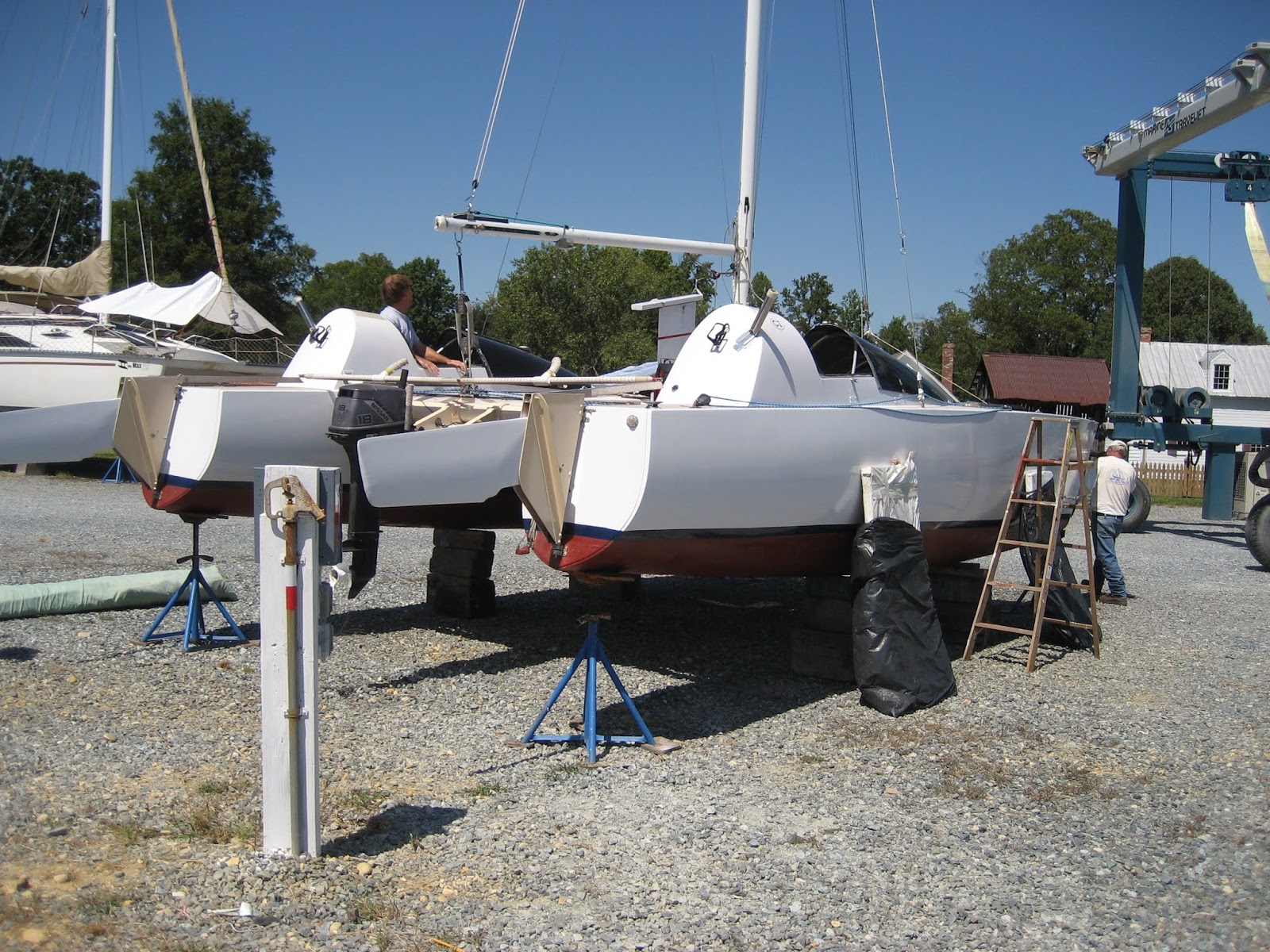
Before: different boat, but same model, same sails, identical problem.


 I admit it; I'm cheap. And I enjoy fixing anything I can, to prove I can. If I have to fix it though re-design, that's even better, and if the repair method is unusual... better still. I'm a tinkerer.
The main sail leach on my boat had been falling off to leeward in a terrible way, as much in light winds as stronger stuff. No just an inch or so - a regular S-shape as much 12" to leeward. Another PDQ sailor mentioned that thicker battens had been installed in his main by a sail maker and had worked for him. Being cheap and willing to make a simple thing more complicated, I decided that tapering the battens by stiffening the back 60% with carbon fiber TOW (tension oriented weave or unidirectional fiber) would do the trick and not thicken them so much that they would not fit the pockets. After all, most beach cat battens are tapered. The draft of a sail is tapered - more in the front, and less as you move aft. And it was also a fix and improvement I could finish for the next weekend!
Batten stiffness is rated by the weight required to deflect a 40" sample by 4". The original battens were 3 pounds for the upper 2, and 4 pounds for the lower 2. The lamination changed this to 8 pounds on uppers and 10 pounds on the lowers, exactly what my back-of-the-envelope calculations using internet carbon stiffness values predicted. Unidirectional carbon works for this project because it is that it is not just stronger than glass, but also much stiffer. If you were to substitute glass it would take many layers and the battens would get too thick to fit the existing pockets. Unidirectional fiber is required; more of the fibers are oriented in the correct direction and they are not deflected into a serpentine path by the cross weave.The forward part of the batten remains nicely flexible. It seems so obvious; the battens on my Prindle were tapered, and in proportion to the PDQ, much stiffer at the leach that the stock PDQ battens.
A simple job, really, easily accomplished:
  • Sand the batten.
  • Cut the TOWs to size.
  • Laminate one layer of 1" wide by 11 oz. graphite to each side. Taper fibers to avoid a hard spot. I did this by ending the fibers about 6" differently on opposing sides.
  • Sand lightly and add a second coat of epoxy.
  • Sand lightly again, by hand, 220 grit or finer, to get any sharp spots.
  • Epoxy again. Optional; I didn't.
The carbon tow came from West Marine, though it is not in the catalog. Defender Marine has a 3" x 50' roll, though I think I bought a `15' roll, and that was just enough. I split the 3" roll to long 1" strips with sharp scissors - delicate because it tries to fall apart,  but not difficult. There were no tricks to the laminating, other than starting at the leach end of each batten, adding resin to only about 1-foot of each batten and letting that soak while I added resin to the first 1-foot of the others, and then going back to the first to finish the full length. Doing it this way keeps the fiber in place, rather than having it creep as you brush the resin toward the luff end.

I am still going to re-cut the sail. I believe I need to remove ~ 3/16" out of 2 seams, 50-70% of the way up. The "after" photo shows some residual sag. But the stiffer battens were a huge help on the sag and treated some vertical wrinkles as well. I will be happy until fall.
An easy project for any boat with full length, un-tapered battens. Like so many engineering projects, it is invisible when well done... but I appreciate it whenever I look up, I found myself able to walk away from a couple of well-sailed 45-footers (all sail boats heading the same way are racing), and my pocketbook appreciates receiving a few more miles from a good sail. The speed difference is appreciable.

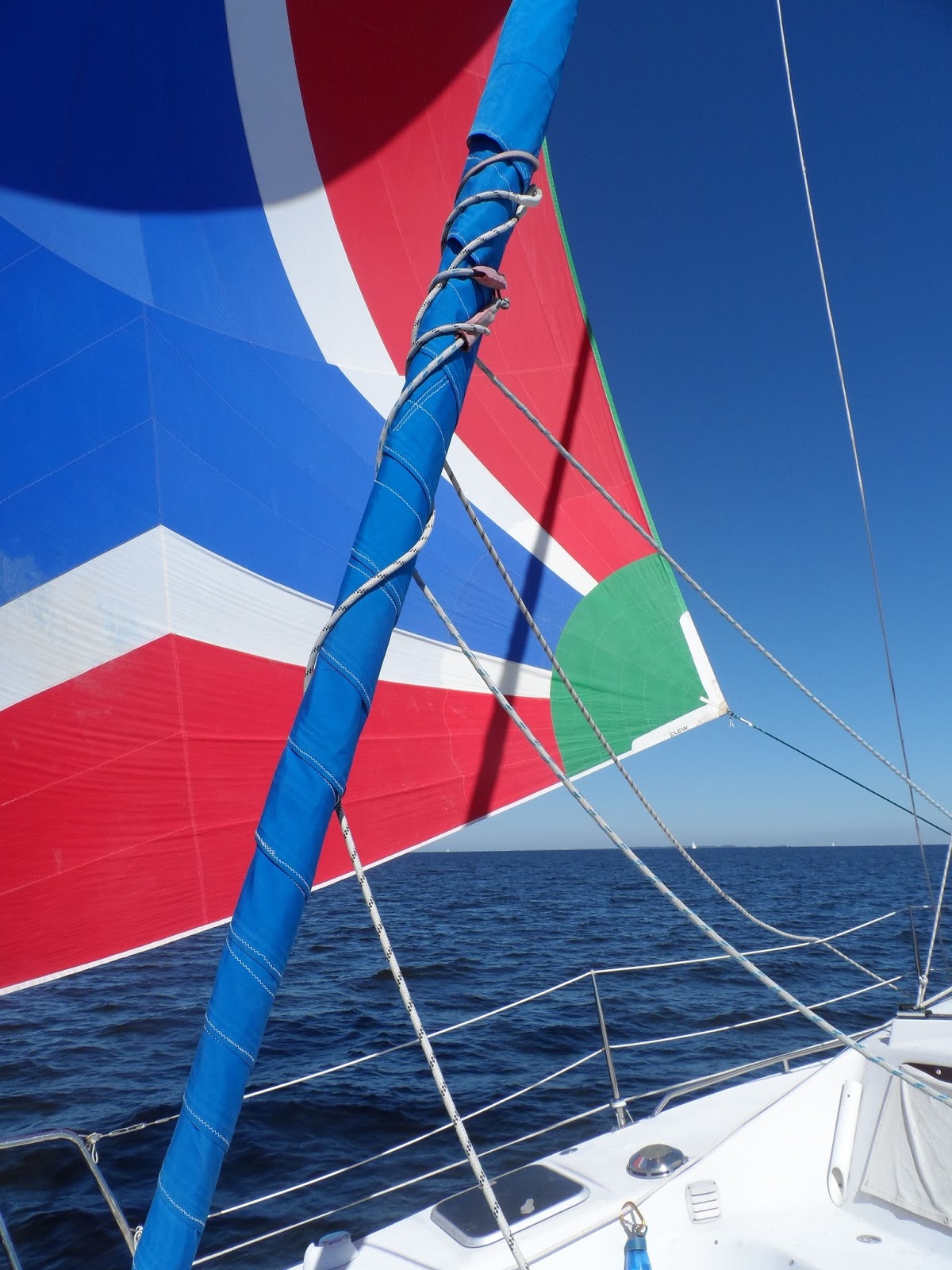
After: not perfect, but much better!

Note, 11-18-2012: In retrospect, I would go even stiffer, 1 1/2 layers each side.  Durability has been fine. Well worth doing.

Monday, June 1, 2009

Better Purchase for Dinghy Davits


rev. 12-10-2011

Hoisting a dinghy with the engine in place can be a real chore near day's end - more so when the stock pulley arraignment is only 3:1 and the cleating arraignment is primitive. On my PDQ 32 it is also frequently necessary to coddle and wiggle the dinghy into place and make little minor lift adjustments. It's 9-foot length only just fits between the hulls.

Better, add real engineered purchase with cam cleats so you can pull a bit at a time, leave the engine mounted (secured to the dinghy, of course), and even have a child help. Do remember when lacing the 6:1 blocks that they require a peculiar 90 degree lacing pattern to keep the friction low:


The blocks are Harken  (triple w/cam and becket and a plain triple) and the line is 1/4-inch.

Also note the spreaders used to get the bow of the tender as high as possible. I later switched to aluminum wire gate climbing carabiners, as they are easier to use and more dependable.

Tricing-up is also a good idea, in any sort of waves or if the boat will be unattended.

-----

Easy Mooring with a Dinghy on the Davits

rev 10-20-2009


The prior owner always kept the dinghy on the deck, since they found no simple way to tie between pilings with it still on the davits; on many catamarans if you connect dock lines to the stock cleats in standard criss-cross practice, they pass right through the dinghy.

The conflict in space is resolved using a short lanyard to deflect the line down and away from the dingy. All of the parts come from the local rock climbing store. As a mountaineer from way-back, they all came from my too-worn-to-climb pile.

The carabiners should be the wire gate type. The conventional biners in the first photograph soon locked up with corrosion and was replaced with a wire gate biners. Wire gate biners are handling the marine environment without corrosion or ill effect. I do feel it is important to use climbing biners because the are MUCH lighter than stainless marine biners, which prevents banging on the hull and gel coat damage. They carry the same 4500-pound strength rating.

Replace the washer under the one of the nuts securing the transom hand rail with a stainless bolt hanger. The nice thing about bolt hangers is that they require only a single (often pre-existing) bolt, are 5600-pound test with a 3/8-inch bolt, and are available in 316 stainless for just a few dollars. Very handy on boats, I have 10 installed, assorted places. Add a 1/4-inch quick link, a 6-inch webbing sling, a carabiner, and wrap the rough parts in 2" hollow nylon webbing to prevent chafe and guard against UV. Neat, durable, and mightily strong.Also a handy tow point for kayaks and dinghies.

How much force? I took a bunch of load cell measurements at the dock in moderate and storm conditions a few years ago. I also did this on bulkheads.

 PDQ Altair 32/34


Saturday, May 30, 2009

My beloved Stiletto, Cherokee Sun, is... sold.


(Dragging the engine to slow the boat for picture-taking, still moving well in very light air)
I was saddened to let this great boat go - I h ave been taking her out for "exercise", even as I work on my new boat. I am always reminded that she must be the easiest to handle, fast, fun boat available. A swift racer, the ultimate day sailer, and a capable coastal cruiser in the hands of the adventurous.

Anyone intersted in these boats should read about them at http://stiletto.wildjibe.com/cgi-bin/forum/view.cgi

 I imagine fresh paint helped. Britesides, rolled without tipping (mohair roller, get the solvent right.)


Monday, May 25, 2009

A Handfull of Minor Upgrades

Nothing earth shattering. Just a few thoughts to share. General cockpit stuff:
  • Wrapping wheel and rear hard top struts with hardware store polymer blend line ($12/100'). We took delivery on the Chesapeake Bay in December, and a stainless wheel is cold even with gloves. Wrapping with line makes it warmer in the winter, cooler in the summer, reduces vibration, soaks up sweat, and improves grip. In fact, we liked it so well we wrapped some of the handholds below deck as well. Very simple, no fancy knots needed; wrap the line around the wheel or post, and wearing a pair of rubber faced gloves, twist it VERY tight when nearly finished. Wetting the line will help maximize final tension.Wrap the king spoke as well, or mark it with a knot. If I had an exposed helm I might use something more UV resistant. (Going strong as of 4-2013)
  • Additional cam cleat for main sheet. Self-tailing winches are nice, but not when the wind is up. I like to have a jammer for every line AND a cam cleat to hold the line instead of using the self tailer groove--it is simply too difficult to ease a self-tailer quickly when sailing short-handed. Additionally, I need cleats to tension spinnaker sheets when not in use, since they do not go through jammers. I don't believe I would like to put a spinnaker sheet in a jammer, as a snarl at the wrong time could be ugly. When the chute is up, it is the big engine and deserves its own winch and cam cleat. Thus, I now have 2 winches on each side, and one cam cleat on port and 2 cam cleats on starboard.
  • Footrest Box. Multi-purpose. Storage. An aid to crew members with bad knees when re-positioned  to just below the big step into the cockpit. Most importantly, leverage for helmsmen that are not over 7 feet tall. Honestly, some of the helm seat spacings are just plain ludicrous, like something out of "Honey, Who Shrunk the Kids?" Later I replace this with a fixed shelf (right) crafted from a teak/holly cabin sole that was ripped out during the remodel (it had a badly damaged end, which I cut off) of a Prout Snowgoose.
  • Pouches below seat. Keeps sunscreen, a knife, and a few tools near at hand. Canvas shoe pouches, cut down and hung from the original seat cushion snaps: $1 from the thrift store, 10 minuets work, no new holes.
  • Sheet pouches behind seat. More shoe pouches, this time mounted with twist-snaps. Three compartments hold sheets, winch covers, reefing ties, and assorted small items. Matching bag on port. Again, a few dollars from the thrift store. I'm not proud... I'm strapped. They also stay open, which I find handy. I don't sail at a 30 degree heel with waves threatening the cockpit, so I don't need shock corded closures.  (Replaced due to rot 2013)

Saturday, February 21, 2009

A Bridle for Positioning the Spinaker Tack--Catamaran Stuff

rev 3-5-2010
rev. 9-20-2016


Note: six months after this blog was posted I quit using the traveler described below and switched to a bridle based on 3:1 tackles from each bow. Unfortunately, the traveler car described below bangs into the bow light, located on the gull striker - I broke a lens and called it quits. Additionally, the traveler does not move the tack as far to windward as the simple tackle, does not control the bouncing of the tack as well in lumpy conditions, and can actually contribute to bouncing. However, I left this blog post up because I was very happy with a similar mechanism on my Stiletto 27 and I believe it will work on some catamarans. It is also quite suitable for non-furling code zeros. On the other hand, I personally prefer to keep the code zero tack centered; if it needs to come to windward, you need the chute, and if it needs to go to leeward, you are probably better off with the genoa.


I actually like a wire gate climbing carabiner (not marine--they're clunky) on the tack, since it cannot trip accidentally and it is easily attached with one hand.

 Secured to he forward lifeline when not in use.

Centered with the wind on the beam.


Keep the head 1-2 feet below the crane. This leaves room for the squeezer and also gives the sail a little breathing room. The sail cut is often based on this. Ask the sailmaker.


So, there is my reasoning. Your non-PDQ 32 application may be different.

----------------

[I left the original design post here just in case it works for you, for some other rigging problem. Maybe a self-tacking jib.]


Spinnaker Bridle Plate and Traveler
The tan plate below the tack of the chute serves as traveler and down-haul, and houses 6 self-contained bullet blocks. Two bullet blocks toward the bottom travel side-to-side on a white 5/16" low-stretch line. A block further up on each side provides 2:1 purchase for the cross-hauls, which terminate in black tandem clam-cleats just aft of the forward beam ends on both sides. This can be adjusted even when loaded-up. Two blocks near the top provide 2:1 down haul purchase on the tack. This line terminates at a tandem clam-cleat on the starboard side. By connecting it in this manner, when the tack is hauled side-to-side the tack height does not change. This cannot be adjusted once it is loaded-up in a strong breeze, unless I add more purchase. Below 15 knots, it's very manageable.

Saturday, February 7, 2009

The Stiletto 27 - You Can Actually Sleep in That?


I freely admit it: I take great pleasure choosing adventures that seem a little bold to the casual observer, and I do as little as possible, at first, to dispel the mystique. My first loves were rock climbing, mountaineering and ice climbing - they share traditions firmly rooted in the collection of bragging rights. I've worked hard to build some skills and to plan, and I will revel in the results. Distance cruising in a small boat always hints at improbability. That we chose some waters few sail... all the better.
The first question about the Stiletto was always "can you actually live on it? Is there a place to sleep?" Well, just. My daughter is small, I am used to backpacking tents, and compared to those it is at least luxury camping. At least you don't carry your home. As the illustration shows there are 2 comfortable bunks, narrow and lacking sit-up room, but long. The other basics are there and no more. You live on-deck.
I cheated though; I took my daughter, who I knew would keep my spirits up. Anything seems possible with ambition, a kids dreams, and enough stout.
Would we do it again? We made many long trips. The weather is the key: warm, always a plan for lay-days, and always a way - an inner passage - to avoid the worst weather. In the end we moved up to a PDQ Altair... really, enough is enough. No, that's not it; the desire to go further simply overcame fiscal sensibility.

Friday, February 6, 2009

Homecoming


PDQ Altair Classic, Shoal Survivor
(the hat was a Christmas gag gift from my daughter)


We're not new sailors. I’ve sailed a Prindle 16 for eight years and a Stiletto 27 for 16 years. My daughter, now 13, has been sharing my longer adventures on our Stiletto for some years now—trips over a week long ranging throughout the Chesapeake Bay and along the Delmarva Coast. But we're small boat sailors. I had only touched a winch on three occasions: sailing on a friend of a friend’s Kirby 24, on a test sail of a Gemini 105 MC, and during the sea trial of my PDQ. I had never touched a roller furler or a windlass or a marine head. They only existed, for me, in the West Marine catalog. What I know of larger boats I've learned from reading and observing during a one-hour sea trial. Now I’ve leapt in with both feet.

I couldn't very well leave my new lady languishing in a marina 4 hours from my house. Never mind that she could happily rest through the winter in Deltaville, a tiny hamlet on the lower Chesapeake Bay, waiting for spring’s temperate breezes. We closed on her in mid-December and I really wanted her back home, in Deale, where I have kept my Stiletto these many years. I wanted to be able to visit her, to play with her, to make her my own. I couldn’t let 110 miles of winter sailing keep us apart.

The previous two weeks had found me assembling a huge mound of essentials required to bring her home. Most of this came from our prior boat; kitchen wares, tools, safety equipment, navigation equipment, anchors, and rope; the 500 bits and pieces necessary to make a boat function. I was less than certain of what the prior owner would leave for us and of what lurked deep in the recesses of the many cabinets. Then there were blankets, sleeping bags, warm clothes, and food for the 3-4 days the trip might take. A camp stove against the eventuality that the propane system might fail. Flashlights. I just managed to force the trunk closed on our SUV and much had over flowed into the back seat.

The plan required a weather window between Christmas and New Years, and between December 28th and December 30th we got our wish—3 day of temperatures over 40° and winds from the south and west at less than 15 knots. My wife drove us 4 hours south from our home to Deltaville, whereupon we hustled to stash and stow all that we had brought, and I ran about the boat like a madman, familiarizing myself with the systems and making certain I had the nominal minimums to get up the road. Regardless the forecast, this time of year a few small craft advisories are an expected minimum and far worse is probable. You expect wind on the nose as you head north up the Bay.

We enjoyed Cars on the DVD player, read, and toddled off to bed.


Deltaville, VA to Solomons Island, MD, 65 miles.
Up at dawn, the temperature dramatically cooler. My first significant project has got to be a heater. With Jessica on hand to help collect fenders and dock lines, we wiggled our way out of an awkward tie up. Oh, what a luxury it is to have twin engines, to be able to spin on a dime—it’s like cheating. The wind was light from the northwest and we began to weave our way out the wire passage that leads from Deltaville to the Bay. The channel markers themselves are set in only about 2 feet of water, scant feet away from the real channel, and a visitor can only thread the passage by observing shadows that hint at the depth of the water—the shoaling is far too abrupt for depth sounder to help. This morning, with the sun just peeking over the horizon and sparkling on the wavelets, there was no hope seeing anything useful. I tasked Jessica with the bow watch, but she had no better luck, and at about 4 knots (I was expecting to find a bottom at just about that spot) I ran the starboard keel onto the sand. Thankfully, she backed off in moments without incident. Safely in deeper water we hoisted the main and 150% genoa and began close hauled up the Bay, bumbling and making mistakes, all of them painless. Wheel steering is unfamiliar to me, and I was all over the place for an hour, over steering and over correcting, until gradually it started to make sense and muscle memory developed. I'm used to a tiller and am compelled to do everything backwards.

Eventually the wind died to 5 knots and it was time to furl sail; we had 65 miles to cover and only 10 hours of daylight. I knew the motoring drill well from our many long trips on our Stiletto; set the autopilot and fight boredom as you maintain a watch of sorts; yet staring straight ahead for the long hours the remaining passage would take be mind numbing. We wouldn’t see other boats this trip; only 2 waterman and no pleasure boats over the entire 2 days. I would read a book and look up each page turn. I would get Jessica to stand watch for short periods. Engines are efficient in lulls and headwinds, and maybe some find the drone comforting. It's boring… until suddenly an engine revs up, unbidden. I immediately shut her down, raised her up to see that the prop was still there and that nothing was wrapped around it, and started it briefly to see if shifted easily and turned. It did. I lowered it back down. Speed with just the starboard engine—4.7 kn. Speed with just the port engine—1 knot. I was fairly confident that the hub had spun, even though I had not heard a collision; I spun a prop on my Stiletto while trying to pull another sailor off a bar in a winter storm, the strain being too much. Unfortunately it's impossible to reach the propeller through the lid, since a change is a simple job, but I didn’t have a spare anyway. We would have a long day, running on one engine, but there was no good reason we couldn't proceed to Solomons Island as we were; it has a wide-open entrance, we have visited many times, and was sure I could manage in the dark if need be. We went on, with a 5-knot wind on the nose for another four hours, anchoring just moments before Sunset.

The evening forecast was revised; instead of the gentle westerly winds we had been promised, NOAA announced a small craft advisory with gusts up to 35 knots for the next day, and a full gale warning for the following day. Though the boat seemed very sound, she was untested in my hands. We anchored with all deliberate speed and set about changing from 150% Genoa to self-tacking jib in preparation for a blow. I had never changed a sail on a roller furler, never seen the self tacking jib that was rumored to be in the locker, and had all of 10 minutes daylight to figure this out. Unbelievably, everything went as smoothly as possible, my daughter and I working as a well-oiled team to lower, fold, re-hoist, and re-tension everything in little more than five minutes. I was thrilled.
No heat—I’ve mentioned that already, haven’t I—but the cold was not intolerable once I started cooking dinner. We brought excess food and good a variety of ingredients and I set about assembling a hearty stew and rice. I never really enjoyed cooking until I began taking longer trips and realized that it's a pleasant way to pass time and the only way to be certain you’ll be well fed. The galley on the Altair is wonderfully efficient; everything at your fingertips and no pacing about is required. When a course is prepared, you pass it up to waiting mouths.

We began watching another movie, The Music Man, and about two hours into it realized our batteries weren’t holding. We had turned off all electrical equipment at the start of the movie, except for the anchor light and inverter, but a quick check revealed the batteries were down to 11.4 V. Concern. We were parked near the channel, so an anchor light for the evening was obligatory, and yet I would have to start the engines in the morning. Technically it is possible to hand crank them; practically, given the geometry and the difficulty I had experienced in starting them with the key, I doubted this was a realistic alternative.


Solomons Island, MD to Deale, MD. 45 miles.

No heat—we had sleeping bags, but still, it was well below freezing this second night. The obligatory midnight trip to the head—a portable toilet I brought along knowing that the marine head had been winterized—was sufficient to get the blood pumping. Nights are long in the winter and there's nothing to do but wait until dawn. I suppose I could've started predawn, but it's not that far from Solomons Island to Deale. How certain was I that I wanted to face the Chesapeake Bay during a small craft advisory in a boat that I can hardly consider my own? It had blown hard during the night—30 knots anyway. I had placed 2 anchors spread roughly 120° in order to address the range of probable strong winds, and had guessed well. Both were deeply buried. The wind had diminished as one front past and the next approach, and we ease your way out of the harbor and began sailing north. However, wasn't long before I chickened out and furled sails as the wind reached 20 knots; both predictions and buoy reports from further north agreed that 35+ knot winds would be upon us within the hour.

The boat handled the rising wind well enough, but with only one engine she often slowed from our baseline 5-knot speed to no more than 2 knots. The ride was drowsy when compared to the Stiletto’s antics in these conditions. I wasn't overly concerned, as the weather forecast was clear that the stronger wind should only last an hour, to be followed by lighter westerly winds that would make for good sailing. Within the hour sails were up and we sailed the remaining distance to Deale, for the first time truly enjoying the motion of the boat and the feel of her under sail. Steering by wheel had become natural, I had learned to trim the sails to my satisfaction, and the wind was delightfully steady at about 15 knots and with waves limited by a nearby windward shore. Delightful. Too soon, we reach our home port and it was time to re-start our lone engine. Groan, click. Groan… start. I've been watching the battery voltage the entire day, hoping that the engine would provide some charging. It didn't. In the morning we had about 9.8 V, by noon perhaps 9.4 V, and by now about 9.2 V. Additionally, the engine had not been running very well, the idle was far too low, and it was prone to stalling when shifting gears. I had learned to be very careful and throttle up rather quickly through the engine’s flat spot. Sure enough, as we approached our slip and idled down, the engine died. Click. Click. “Jessica, quickly, drop the anchor. Just push the forward button until I ask you to stop.” Nothing from the windlass. We had a second anchor available to go fairly quickly in the stern locker, but it occurred to me that the wind was appropriate in direction and strength, and with the roller furler I could maneuver the self-tacking jib very quickly if I left the jammers open and stood on the trampoline. I directed Jessica to steer for our slip and I pulled the jib in and out, and moved the clew this way and that, and directed Jessica to steer this way and that as we moved closer. And a miracle occurred; we ghosted in the slip and about ½ knot, dock lines at the ready, and tied up pretty as a picture. I felt unworthy. I have made docking look so ugly so many times, I gather I had earned a break. Perhaps years of practice with the Stiletto helped as well—at only 1300 pounds and no rub rails, she blew around quickly and challenged her crew ruthlessly to keep her off barnacle-encrusted pilings. We had learned the craft.

We spent the afternoon searching through the bowels of the many compartments, sorting trash from treasure, and discovering what had conveyed: 20 stubby pieces of old rope, a pile of paper bags, the horribly weather remains of the original cockpit enclosure, 45 half used containers of every wax, polish, and lubricant known to the marine industry, frightening PFDs, 3 old mops, and on and on. After hours of searching 2 propellers materialized from the most remote corner: one brand-new in the box, one used (the prior owner tells me that there is nothing wrong with the used prop, but I think I spy some evidence the hub has slipped a little bit and I’ll have it re-hubbed).

I am home now, but the horizon is calling. My daughter has made me promise to take her around the Delmarva again. I’ll ignore them both until spring. There are so many harbors and coves and beaches on the Chesapeake it takes a life time to visit them all, and when you have seen them all, you can start over at the beginning, as faded memory renders them new again.

Short Summer’s Cruise

August 2008

My daughter and I have gone on numerous trips around the Chesapeake Bay and around Delmarva—usually we aim to visit places that are out of the way new to us. This trip was different; we would be visiting familiar places, but favorites. No soulful experiences, but a pleasant trip I thought worth sharing, and one any sailor with a shallow draft boat and access to the central Bay should consider.
Day one Deale to James Island 22 miles
After delicately prying my 13-year-old daughter out of bed, driving the boat, and packing our supplies into the limit storage space our catamaran provides, we left the dock at about 10:30 a.m. A modest Northwest breeze sent us on the broad reach of about 6-8 knots under full main and spinnaker. Gradually the wind lightened and moved dead aft, and her speed dropped to 3 or 4 knots, but we had nearly arrived and motored the last few miles of approach.
James Island used to be a very sizable island, in fact a peninsula on the south shore of the Little Choptank River. However, with falling sea levels—yes I do mean falling sea levels, since it was a sandbar formed when sea levels were much higher—it has eroded into three islands that will probably disappear in my lifetime. You'll not find a description of James Island in any guidebook and little on the Internet. I spotted it on Google Earth as a lonesome spot with potential, researched on the Internet that the owner doesn't mind visitation by low impact users, and stopped by briefly on a trip earlier this summer, while passing from Smith Island to St. Michael's. What we discovered was one of the nicest little desert islands on the Chesapeake Bay. The east side of the center island forms a beautiful sandy crescent, protected from all but east winds. From any other direction doesn't look like much.
We arrived mid-afternoon, anchored near the shore and next to two small powerboats. We walked the length of the island to reacquaint ourselves with the beach. Jessica explored the tidal pools at the north end. She then began to lead me through the brush and in the middle of the island… and within 15 seconds came charging back at me, followed by a cloud of flies and mosquitoes. Her assault on the interior of the island had been repulsed.
The rest of the afternoon was spent… well, not really doing anything. That's an odd choice for an adult like me, who is inherently goal oriented. Not that I'm a super achiever in business. Not that I'm a workaholic. But my goal is to go sailing I want to go sailing well. If the goal is to go rock climbing, I want to climb well. Today my only planned activity was to relax, and I suppose I did that well. With a book in hand, bug spray applied to the back of my neck, my boat anchored 30 feet off the beach, and the calm sandy bottom on which to plop my butt (chest deep in the 80 degree waters of the Bay), I proceeded to think about very little for the next few hours. I fished a little, but only tiny croaker and spot were biting.
We settled down for the evening. A passing thunderstorm grazed us, providing some fresh air but no rain. We watched a Jackie Chan movie on a portable DVD player. We tried fishing again—I reasoned that if there were small croaker during the day there might be larger fish at night—and we cleaned up. One fat fish after another, all over a foot long. “Fishbites” was the trick, an amazing fake bait. I tossed the cleanings off the stern, attracting squadrons of smaller fish.
Day two James Island to Santa Domingo Creek / St. Michaels 20 miles
Unexpectedly the wind kicked up from the east northeast during the night. Though my daughter was soundly sleeping through it, the 2 foot waves we that rolled in woke me up rather early. The bottom is hard sand and with two anchors down there was no concern of dragging, but there was no chance of sleeping either. It was easy enough to raise sail right at anchor and to sail the entire distance to broad Creek in one tack, not at any great speed, but with perfect relaxation, the sun working its way up through the morning clouds.
Once at the head of broad Creek it's necessary to drop sail and motor up to the end of San Domingo Creek. A close examination of the map will show this creek provides a nice backdoor to St. Michael's; by anchoring near the town commercial dock at the head of the creek, or even running a very shallow draft boat ashore it is possible to gain access to St. Michael's without having to go all the way around Tillman Island. It's also free. Don't tie up to the face of the dock; commercial use, unloading crab boats, and recreational craft are not welcome there. It is possible, if your boat is very shallow, to tie up near where the dock and land meet, in water that is useless to larger workboats.
We walked the town, got ice cream, shopped the shops, visited the Maritime Museum (very nice - touring the inside of a screw pile light like the one at Thomas Point, is a highlight), stopped for lunch, and managed to get back to the dock just in time to beat a thunderstorm. Well, we didn't beat the thunderstorm. We managed to get about a half a mile before we had to quickly anchor in a small cove and dive below decks. I don't mind rain but I do mind lightening. The storm passed quickly, we motored about 5 miles toward intended overnight stop near the mouth of Broad Creek, anchoring securely in a small cove near another town dock. Nothing remarkable there, but we pottered around shore for a little bit, until the sound of thunder became undeniable. The passage of the storm itself would fill a small posting—sufficient to say that wind to 60 knots and hail were predicted, and they arrived. It certainly seemed that some god was throwing buckets of water filled with gravel at the hatch, as we surged back against the anchor. I had 2 well set hooks in and we didn't move an inch.
This too passed, I was able to take my time grilling up the fish we caught the night before, served with corn on the cob and rice. We enjoyed this in peace and quiet while watching another movie, “The Maldonado Miracle.”
Day three Broad Creek to Deale 20 miles
This should have been an uneventful day, except that the wind was blowing on the nose at about 20 kn and the waves were running 3-4 feet. There isn't much to describe other than sailing to the weather under reefed sails and getting wet. Within the hour we shook out the reef and continued under full main and storm jib as the wind moderated a bit, and the waves get smaller as we reduced their fetch. Worth mentioning perhaps, is that storm jibs are not solely for strong winds. Going to the weather I will normally go to a full main before changing up to the next larger jib. I find that even the smallest jib does a good job of cleaning up airflow to the main and giving the boat a wider bucket and more punch, but it is still a nice flat sail and feathers easily with the occasional gust that would otherwise overpower the boat. The mainsail is easy to feather; a larger jib is inclined to flap, and then grab, flap, and then grab. If you ease a large jib, it simply becomes more full; exactly what you do not need in strong winds.
That is the end of the story. Not much the story really; more of an invitation to visit James Island and to visit St. Michael's by the back door. It makes a wonderful three-day cruise, particularly suitable for smaller boats. Kids help too.