Pages
- Home
- Introduction to Sail Delmarva
- Site Map
- Anti-Chafe Gear
- Marine Winterizing Primer
- Man-Overboard Recovery and Climbing Gear
- Holding Tank Odors vs. Carbon Vent Filters
- My Other Blog (Chesapeake Gunkholing and Kayaks)
- The Purpose of Work
- Diesel and Biocides
- Practical Sailor Magazine
- Good Old Boat Magazine
- The Bookstore
Wednesday, January 2, 2019
How Long Does Synthetic Rigging Last?
But just because it is corrosion resistant and fatigue resistant does not mean it lasts forever. 6-8 years is safe in the tropic and probably 10 years here in Maryland (less sun), but I've seen older Dyneema break, and the remnants tested at only 25% of new strength (probably quite old, but not known). Same with lifelines; nice for 6-8 years, but after that it depends on how over-strength you went.
Just make sure you put it on a schedule, and like any rigging... inspect it!
Saturday, December 29, 2018
I Just Want the Boat to STOP!!
I often read of a "last chance" line trailed behind the boat. The line described was most often tragically short. Sail magazine described one only 15 feet long. If you fall in head first, angled away from the boat, and the boat is moving at a 5-7 knots, 75 feet is the minimum required distance based on my testing in summer weather. You better have 150 feet if you want any hope of finding it in adverse conditions. They also think that they can either make the boat stop by tripping the rudder (the boat may just tack away and keep sailing--you did not take the time to trim it for heaving to, or bring the rudder back up) or simply haul themselves back to the boat (impossible over about 3 knots). The other thing they always have in common is that they have not TESTED their theory by jumping in. Man, if you have not tested it, don't even report it as an idea. Someone might believe you.
I imagined myself hanging on the said rope at 7 knots, waiting to get tired and let go. I've been towed as a water skier, so it was not hard to imagine. I also tested the speed At which I could hang on to a 3/18-inch floating line, and the speed at which I imagined I could (dressed in foul weather gear and a PFD) haul myself back to the boat. It becomes clear with in moments that what you will pray for is for the boat to STOP. Nothing else. You would give anything to make the boat stop, like dropping an anchor (see where we are going with this?). And as it turns out, that isn't really so hard, at least not with smaller boats.
Basically, it is a parachute with the floating line as the rip cord. You don't need to pull hard, just enough to pull the gear from the storage bag on the deck. The chute and rope stream out, and about 10 seconds later, the chute fills, creating a whole lot of drag. A nylon climbing rope provides the energy absorption, bring the boat to a slow stop (about 1-2 knots, even with the engine at full throttle). All that remains is to pull yourself to the boat, hand over hand, which is not very difficult with the boat nearly dead in the water.
Yup, I tested it repeatedly, sometimes powering, sometimes under sail, upwind and down. It didn't matter. The success rate was 100%. All I asked of the crew was to keep filming.A seemingly crazy idea that simply works.
I'm not at all surprised. For years, in testing, I would drop drogues and sea anchors off the transom at full speed to create maximum impact force, often using non-stretch rodes and larger boats. Although the strain could be high, nothing ever failed.
Staying on the boat is better. Stay low and clip-in when it gets rough.
[Details are in Practical Sailor Magazine. Obviously, the engineering varies with the weight and speed potential of the boat.]
Friday, December 28, 2018
Tiller Reinforcement
Because the rudder swings down and into a slot in the hull when the rudder is lifted, the pivot was a counter sunk flat head. A flat head makes a nice wedge, and sure enough, most of the tillers developed splits.
Tuesday, December 11, 2018
Actual Anchor Loads
I spent a LOT of time researching this topic, through the literature and by staring at a load cell for hours and hours. I used all sorts of rodes and snubbers, in all weather, on a number of boats.
ABYC (American Boat and Yacht Council) set standards for rodes and deck hardware 50 years ago, based on testing with boats on all-chain rode in open harbors and shallow water (but no breaking waves) and no snubber. In fact, these values are VERY close to what I got testing in similar conditions. This is very much a worst case situation and is something you should NEVER do, but is a good basis for the design of something that cannot fail. I don't think I've ever heard of a system meeting Table 1 requirements that was in good repair failing, outside the eye of a huricane (an even then it isn't the chain that breaks; they either drag or the roller and cleats fail.
Interestingly, every investigator reported 3-5 times less when they measured the strain on their boat (me too). Of course, they wisely anchored in deeper water (lower waves and more catenary), used rope, or used a snubber.
Looking only at the 60 knot row, which is very likely the most you will ever face without some protection from trees or shoreline, we see that the wind load is only about 20-25% of the ABYC load. Waves and snatching make up the rest. If you use a long chain in deep water (at least 20 feet), a long snubber (35'-50'), or a rope rode, the load will be only 25-30% of the ABYC value.
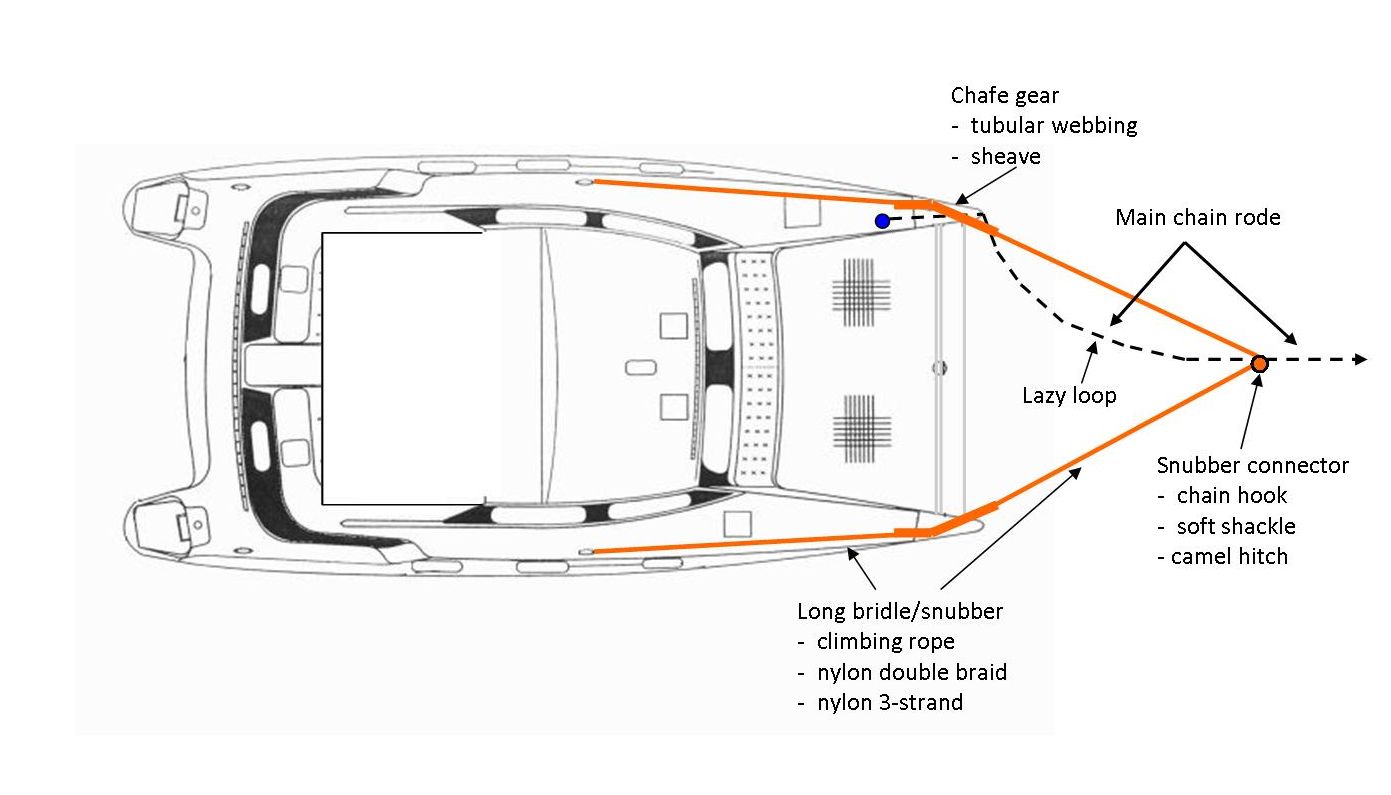
For larger boats or those around coral and rocks, all chain is nice. Rig a LONG snubber, even if you have to cleat it at the mid-ships or stern cleats to keep the connection off the bottom.
I've even gone to a Dyneema bridle to reduce yawing and to reduce the sometimes-excessive stretch of all-nylon rode. Because the bridle does not distort under shifting loads, yawing is reduced.
Monday, November 26, 2018
Northill Anchors
- Folds flat
- Very easy to assemble, better than any other break-down anchor (less than 10 seconds)
- Works on any bottom type
- Good reset behavior
- Good holding capacity (450 pounds for 12-pound 6R Utility in mud), comparable to many new generation anchors. The cross stock adds a LOT of holding power when it meets the bottom. I've tested this anchor to 750 pounds in fine sand and it didn't budge.
- The lazy fluke is sticking up. A problem if the tide does a 360, which it can.
- Unlike new generation anchors, it does not rotate to face a shifting breeze. Instead, it pops out like a pivoting fluke anchor. Fortunately, it is much better at re-setting. Thus, the fault is nearly forgivable. Considering fault one, it's not the anchor to use when tidal reversals are expected.
Sunday, November 25, 2018
The Tradition of Tandem Anchors
- The anchors were both traditional fisherman style. There was no back to roll over onto. If it rolls, it is ready to dig again.
- A fisherman is poor in mud but good in rocks.
- A fisherman doesn't really bury well, so the negative impact of secondary rode tension is small.
- V-arrangements are fatal with fisherman's anchors; you will foul for sure. So this is the only logical 2-anchor rig.
Note 3-2020. I did test this with a Northill. As per other trials, the secondary buried and the Northill was suspended above the bottom. Useless. As with all in-line tandems, it probably works on hardpan.
Tuesday, November 20, 2018
Why does the World Sailing Off-Shore Rule Forbid Wider Pulpits?
But the Off-Shore Rule is rather specific:
Not only does this make for a safer work area, it avoids jib impingement.
I'm confused. It seems like a good idea to me. I understand why this would be important farther aft, since rail meat would be sitting farther aft. but that is a different matter and easily excluded, if that is the intention.
Thursday, November 15, 2018
Hugo Boss Sets a Record, Over 38 Knots
Wednesday, October 31, 2018
Man, We're Getting Old... and It's Getting Worse
The conclusion of industry analysts is while new boaters come and go, the core of long-term sailors is stable. Those of us that become addicted occasionally sell a boat, but then by replacement. That's certainly my story, having owned a beach catamaran, Stiletto 27, PDQ 32, and now a Corsair F-24 Mk II.
Unfortunately, new boat owners come, but mostly go. As a result, boating is in gradual decline. Some point to New Age alternatives--the internet and other sports. Some correctly point out chartering is on the rise--boat ownership and all of the maintenance that goes with it is a good fit with the new generation.
Small boats are still a healthy industry. My daughter, for example, would love a sailing dinghy and I'll bet she'll buy one someday. But you can't see her owning a bigger boat. It wouldn't fit her needs, and the maintenance and fiddling would never hold her attention. I can see that. It feels pretty irrational at times to me.
The result is that we sailors are getting older and older. It doesn't just seem that way, it's true. I'm okay with that. By the time the sail population ages enough that my target market has evaporated, I'll have run out of things to write about.
Bow Wind Indicators
Rev. 7-25-2024
Masthead wind indicators are ubiquitous. Unfortunately, they can be hidden by sails, put a crick in your neck, and take your eyes away from where you are going.
On beach cats, a vine under the bridle is common. It's right in your line of sight when the action gets fast and allows you to watch the lee bow, as it tries to turn submarine.
I've always had vanes on the bow. The crew like them both for sailing, and just as much for hoisting sail and anchoring; they aren't all sailors and they don't like looking up while driving forward. They have a point. It can be tricky to locate them so that they are not damaged. In this case, the pulpit and the bow sprit up-haul line (blue) have kept them safe.
Starboard is the Davis Black Max. Port is Schaefer Little Hawk Mark II. The Little Hawk proved a little more durable and more sensitive. We're going to be trying a yarn version this summer (2024), but prior experience on the PDQ tells us it's easier to read the vane from a distance.
Why two vanes? I have been testing vanes for 2 seasons for an up coming article, rotating models from time to time. There is nothing like time-in-service to sift out the top performers.
The Bottom Line. I like them all. I find them handy on every point of the sail, but perhaps most useful tacking and jibing. Look for the Write-up in Practical Sailor Magazine.