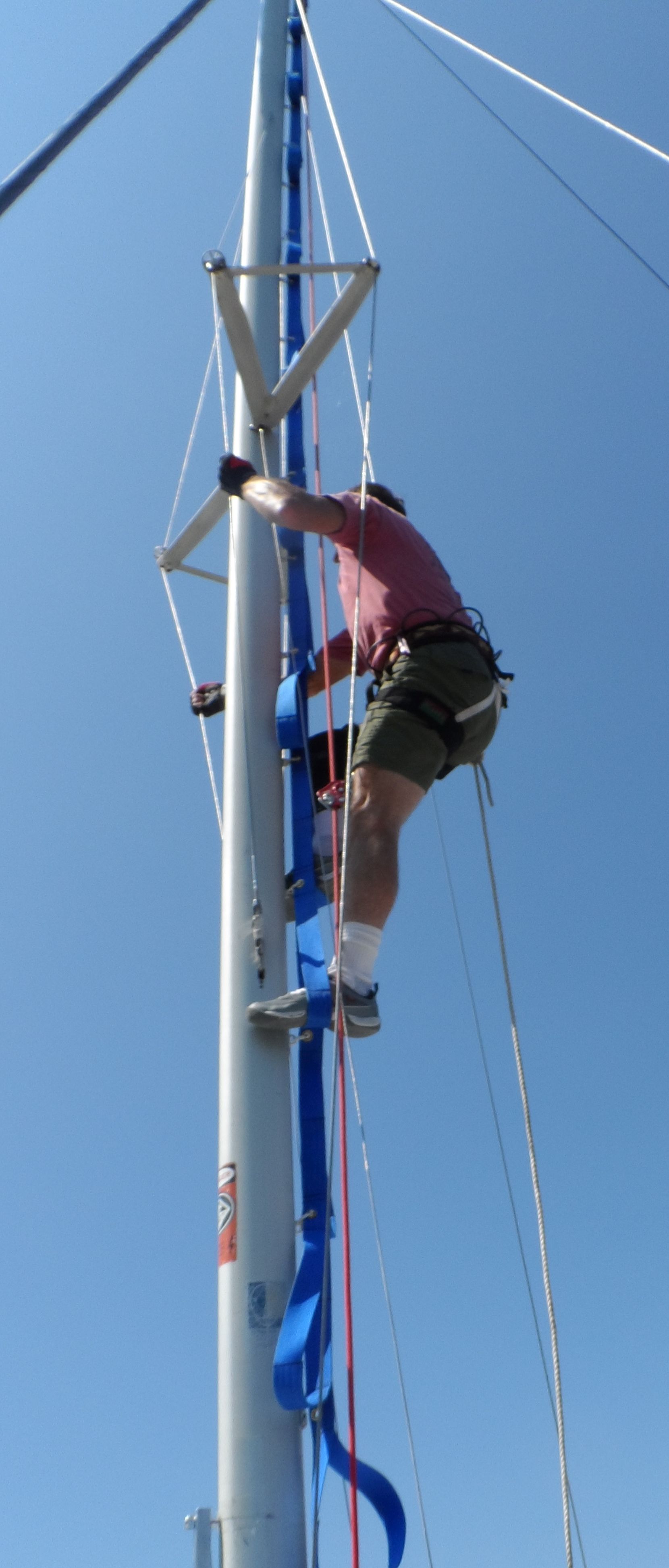
Extension Ladders—the
Rope Climbing Alternative
Say I don’t like the idea of dangling from a finger-thin
line the length of which I have not inspected. Of course, I could swap it out,
but that still leaves the condition of the pulley in question; I know a guy who
decked-out after the pulley axel failed, dropping the rope onto the sharp edge
mast cutout, cutting the rope. Obviously I can use multiple back-up lines, but say
I just don’t like the idea. I would rather use a ladder because it gives better
leverage and is less tiring. (The writer is actually an avid rock and ice
climber, with 30 years of active climbing all over the US. He trusts ropes just
fine, but prefers the stability and ease of a ladder when practical.)
Is it safe? We seldom observe ladders up masts—unless we are
talking about mast steps, which I don’t have and don’t want. Or perhaps the
project is installing steps up to the spreaders, and I just can’t see myself
working for that long hanging from a string nor making so many trips up and
down for bits and pieces. Well, the answer regarding ladder safety is a
qualified “yes,” as long as the boat is located in a well protected marina and
the ladder well secured. Weekdays are best (fewer wakes). We’ve used ladders many times, and they remain
a favorite, in spite of having racks of climbing gear and no fear of ropes and
high places. Sometimes a ladder is simply better. But I take precautions; a
safe ladder makes for more efficient work.
·
Not on the hard. While some boats may be blocked
well enough for this—multihulls come to mind—it doesn’t matter because yard
rules prohibit climbing the mast of a blocked boat. Too much weight up high and
too much liability for them. The idea of ladders on the elevated deck of a
blocked boat justifiably gives them the willies.
To the spreaders. I don’t like going too much past
the spreaders for a number of reasons. On smaller boats—less than 30 feet—the
ladder adds weight to an already top-heavy situation. The deck space for the
foot is limited resulting in a ladder set at too steep an angle. For larger
boats, the required ladder is simply impractical. Extension ladders become
progressively more ungainly the longer they become, and a 40-foot extension
ladder is a monster for one person to handle, or even for 2 on the deck of a
modest boat. A ladder reaching only to the spreaders, on the other hand, can be
quite reasonable.
Another reason we like ladders to
the spreaders is that it seems most of my work is there, on the forward side of
the mast. A ladder gives best access to the steaming light, deck light,
lazyjack anchors, flag halyards, spreader boots, and RADAR. On a previous fractionally
rigged boat, we could reach halyard exits and shrouds. When climbing with ropes
the mast is ascended from behind because the main halyard is used. On the
forward side only the spinnaker halyard—if there is one—is available, and often
it is suspended from an external block on a crane; the spinnaker halyard is not
recommended for this reason. A genoa halyard is available, but you have to
lower and clear away the sail. We still use ascenders when we need to go clear
to the top, but that is nearly always just an inspection trip, without the
repeated up-and-down laps for tools and parts.

- Tie the boat more tightly. While docklines
require some slack to deal with tides, the motion at the spreaders will be less
if you minimize the slack. Very tight lines can actually increase motion, so
leave about 1-foot of slack. Remember to re-set the lines when you are
finished, and adjust them as needed if the tide is swinging
- Light weight ladder. While ladders used in
industry are heavy duty and are rated at 300-375 pounds, it will be far more
pleasant to use either light commercial (225 pounds) or household (200 pounds) ladder
on the deck of a boat. They are much easier to work with, and because of the
way it is to be secured (to the mast and deck), it will be stable and reliable.
Of course, if you’re a big guy you will need a ladder with the proper rating
and should be able to handle the weight.
- Secure the top rung. Pad the top rung of the
ladder by wrapping with a towel secured by sail ties. Additionally, secure the top
rung to the mast with a sling around the mast and back to the ladder. This
should be an easy fit, free to slide, but not so loose that the ladder rails
can slide completely off the mast to one side. This will guide the ladder as it
is extended, siding up, and can be tightened once climbed, if desired. This
sling should be strong, at least 3/8-inch or 4000-pound breaking strength, like
any climbing anchor. Second, attach a spare halyard or topping lift to the top
rung. This can be used to
help raise the ladder and provides some additional
security.
- If the halyard is used to lift the
ladder it can be advantageous to lash the sections together. Otherwise they may
pull apart.
- Raise the ladder to within the range of angles
marked on the ladder. Too vertical is neither safe nor fun. It will also result
in slower work.
- Secure the base. Secure the base of the ladder
against fore-aft and side to side motion using the genoa sheets (I used
spinnaker sheets in the photos) to prevent side-to-side motion. Do not
over-tighten with winches; ladders can be pulled apart. Secure the bottom rung
to the mast to prevent kick-back. There should be NO possibility of motion. Pad
the deck if you must, but the rubber feet will be more secure and should not
unduly load the deck, no more than jumping down on a heel. Place them carefully
and they should not mark. If there are spikes on one side, tape them up. Thus
secured, the ladder should be as safe against falling as any fixed ladder, and
at a better angle than many. However, boats move, and that requires additional
precautions.
- Climbing harness. If wakes can cause the boat to
roll, a climbing harness can be a good idea, either
belayed by a crew member or
attached to a tight safety line paralleling the ladder by a rope grab. Unlike
climbing by rope, however, there will be no discomfort from harness pressure. Harness is generally not needed on catamarans,
though this depends on the person and the work to be done. If two hands are
needed, use a harness, if only to tie-off once at your working stance. The
tie-off should be nylon—the impact force of even a short drop will shake your
teeth loose and can create dangerous loads. In principle, the tie-off is for
side-to-side motion only, not falls.
- Climbing and work posture. While climbing keep
both hands free. Don’t carry anything, but rather trail a line to a tool bag,
as though you were ascending by rope. Tighten the rope securing the top rung to
the mast as soon as you get there. Have a way to secure all of your parts and
tools while working, whether by lanyard or deep-sided bag. While working, be
certain to keep your knees locked into the sides of the ladder. Use a firm and
slow hand with all tools and parts; a light touch is prone to dropping things.
Like many things, safety comes down to being methodical.
Secure the ladder in all directions; it should not be able to move, even if you
tug hard. Climb carefully, prepared for motion at all times. People do fall from
ladders, but seldom those that are properly secured. Be safe.