Showing posts with label Just Thinking. Show all posts

Thursday, August 1, 2024

Woodwork: the Finishing Bench and the Sea Chest

10-17-2012, rev. 8-1-2024
 
 Certain objects cry "nautical" from the first glance: A wooden ship's wheel, a brass lantern, wooden shell blocks. Not practical, though, and cliche on a modern boat. There are items we accept as functional and usual: a stitching palm, a life ring with the yacht's name, coach whipping on the wheel or tiller. And then there are half forgotten objects with real utility, in my opinion at least, underutilized.

 The Finishing Bench. Still used by traditional sailmakers, a simple bench holds the implements used for roping, adding a grommet, or mending. I made this one about 5 years ago from nothing but scraps and a little varnish, a very pleasant way to spend a few winter evenings. Mostly it sits by my favorite chair, holding magazines and what ever books I'm reading, but my stitching tools and materials are ever present on the far end. Yes, I catch a pant leg on the bench hooks now and then. But whenever sail work is required I carry it out in the front yard where it serves its traditional purpose very well. Smaller projects get sewn up right in my chair, reaching back for traditional tools and materials that are kept conveniently at hand.

No directions. I just followed an old illustration and fit it to the scraps I had. I suppose they were generally built that way, from bits and pieces.
  • Cleats on the underside reinforce the legs.
  • Numerous holes and vertical dowels on the cutting block secure spools of thread or hold knives and fids. Some holes only go part way through, holding needles and small things.
  • Dowels angled just above horizontal on the cutting block end hold scissors, palms, webbing, thread, and a small ditty bag.
  • Bench hooks need to be sharp, and it is handy to have 2 different lengths. These were bent from steel tent skewers.

 
That first step is about 30 inches.
Sea Chest. Although my boat has some cavernous lockers under the bunks and salon seating, there are never enough small lockers handy in the staterooms. Additionally, getting into the bunk is rather athletic, as the bunks are high and without steps. Additionally, a seating platform with storage blocks the way to the bunk, and it is at an unfortunately awkward height, far too high for putting on shoes. At first I built stools, but they were really too small and too single purpose. A small sea chest, fit to the space, is the perfect answer.

Though I didn't take any pictures of the construction process, anyone with the carpentry skills to make a box should be able to do just as well.
  • Traditionally these were painted a muted color and only the inside of the lid would be decorated and bright. Paint best withstood hard knocks, and the interior decoration reminded the sailor that his chest was the one thing on board that was his. However, my wife liked it varnished--all of the reproduction examples I showed her on-line were varnished--and it works, I think. Perhaps I'll paint it later; if so, going from varnish to paint is more reasonable than the reverse process. Because I originally planned for paint, I made no special effort to hide fasteners; I focused on building it strong enough for regular use as a step. I think I like the utilitarian look.
  • Strap hinges are traditional, but a piano hinge fits better, and I had a cut-off. I cut a recess for the hinge so that it closes perfectly, with no need for a chain and with all of the weight transfer directly to the sides.
  • Be mindful of protruding hardware. While a few scratches didn't matter on a whaling ship, they do to us. For example, the handles were traditionally attached with exposed rivets, but I substituted counter sunk brass bolts. Same on the inside; nothing to snag on clothes. I smoothed all interior hardware with a Dremel tool.
  • Side Relief. A characteristic of sea chests is that the sides lean inwards. The practical reasons for this only became obvious as I measured the intended space: if slammed against a bulkhead (ships move) the lid will still open and the handles are still accessible; they better resist tipping; there is less binding when push into or pulled from a tight space. The trim strip on the bottom also helps; it takes a beating and thus should secured with screws, not brads.
  • Rope handles. Mine are boring. Starting with a bit of old 3/4-inch 3-strand line, I placed 2 whippings about 9 inches apart, unlaid both ends for about 3 inches, and pinched the strands between handle blocks and the chest sides (I had drilled 1/2-inch holes with the handle blocks clamped together, making half-round groves for each of the three strands), trimming the excess. Tape held the strands in in the groves while the bolts were tightened. Strong and compact enough to fit the narrow space I had to work with, but not fancy; I lack the marlinspike skills to do a proper job. However, even simple rope handles are strong, comfortable, and non-scratching.
  • Square the sides up on a flat floor before screwing them together; you don't want a rocker. Likewise, true the lid to the top; otherwise the hinges will work loose in time. When working with scraps, never presume anything to be square or true.
  • No latch. I didn't see the need for my purposes
  • Hold down. In the stern of a catamaran the motion is never lively enough for the chest to move, but I can certainly imagine boats and places where this is not true.
  • Lid cleats. These not only hold the 2 boards that make the lid together as one, they are also carefully tapered to lock the lid in place when close, transfer lateral forces when used as a step to the sides and away from the hinge. Remove the hinge and the closed lid does not shift, not a fraction of an inch.


Something more traditional


Tool Box. There is a window shelf outside the head that is of no particular use. Sometimes we keep shoes there. Because of the hatch, spray is always a possibility, limiting possible uses. Nothing tall that might block the hatch. I reason a light box I can pick up and move will find some purpose and stow some clutter. I like the semi-traditional look, it kind of works on a sailboat that is only semi-traditional; though sailing is by nature nostalgic, multi-hulls have to keep there distance.

A simple scrap lumber project, it is made of 3/4-inch pine and 1/4-inch ply. What will we keep in it? I won't know until we've been cruised with it for a while.

__________________

All from scraps. In the first example, I used a few boards that were left in the basement by the previous homeowner and a bit of left over shelf. The dowel was from a discarded seasonal decoration. In the second example, I salvaged a neighbor's old garage shelves and some line left over from a Practical Sailor testing article--the stuff we found under a dock and cleaned. The brass bolts--16 x #8 x 1 1/2"--were also left overs from a writing project--laboratory corrosion testing of gasoline anti-corrosion additives. I think that is the way these sailor's tools would have been made, from the bits and pieces. The finishing bench was free, the sea chest a $2.45 project (a bit of 1/4-inch plywood for the floor--I wanted something lighter than the scrap I had on hand). The tool box was even cheaper and quicker, though I took my time and finished it neatly and well. Very affordable.


    When is Smaller Better?

    9-16-2017, rev. 8-1-2024

    Human nature--or at least American nature--is to covet and to believe that bigger is always better. But if that were true, I wouldn't get so much enjoyment from my thrice weekly bike rides. My theory with rode vehicles is that fun is inversely proportional to size:

    • Skate board or in-line skates. I haven't been on skates in a several years, not since I injured my knee. Maybe it's time. I have several pairs.
    • Bicycle. 
    • Sporty car
    • SUV
    • Van
    • Winnebago
    • Semi-trailer
     Actually, the last two are fun for the first little bit, just for the adventure. Each has certain utility. But if I just want to head out for a few hours of smiles, the bicycle wins, hands down. I even switched from SUV (Subaru Forester) to sporty car (Mazda 3 hatchback) a few years ago, and I'm loving it (and the 43 MPG doesn't hurt either!).


     For the last six years, this aluminum and carbon toy has helped keep me in shape. And it is fun.
    Does the same hold true for boats? I think it does, perhaps even more so if we include the difference in maintenance requirements. Big boats are work. And even more than the bicycle-to-RV continuum, small boats teach sailing, while large boats teach systems. Everyone should learn to sail a small boat first.

    Not counting a few rentals, my first sailing experience was eight years with a Prindle 16 beach catamaran. When the wind gets up, small, over-canvassed boats are strict teachers regarding sail balance, trim, sea state, and situational awareness. Of course, I couldn't leave well enough alone, and I eventually added hiking racks and a bow sprit for a chute, making her quite the rocket.


    I got married, decided to get something just a little more group-friendly, but still lively. The Stiletto 27 is really just a beach cat on steroids, just as fast and only a little more stable. This is not a boat to learn sailing on; capsize is possible, and unlike a beach cat, you can't just flip her back on her feet and laugh it off. She taught me more conservative sailing and introduced me to cruising. Although her accommodation were primate, she took us on some long trips (weeks), germinating the cruising bug. Although she was not as nimble as the beach cat, she was still quick to tack, would motor at 12 knots, and we once hit 23 knots with the chute up. Scary. And fun.


    Soon I had real cruising ambitions. A larger boat--my current PDQ--would accommodate the family and some of my daughter's friends on long trips in a reasonable level of comfort, and with a fair turn of speed. Motoring is only 7.5 knots and sustained sailing is generally 7-10 knots (not surfing), but we can maintain those speeds for 10 hours, because she is much less tiring to drive. In fact, her stability is so great she is on autopilot 95% of the time. I measure wind speed by a gauge on the dash and direction by wind vane, not by the wind in my hair. She's comfortable in a near gale in the winter, but now I'm insulated from the actual sailing. And yet in a good blow she does come alive, and 9 knots to windward is not unusual. She can really drive.


    But it's not like riding a bike. The intimacy is lost when a boat becomes large enough for cruising. In bad weather we want to be insulated from the elements. We call that comfort and seaworthiness. 

    The next boat, just month after writing this, turned out to be a Corsair F-24, which I had coveted since the first came out. It looked like fun. It is. I consider it my daysailer for grownups. Lots of strings to pull, easy enough for one person but easy room for 2-3, fast enough, weatherly and fast to tack, yet stable and seaworthy enough.  I'm going to keep her for a while. I might change the waters rather than my boat if my abilities change.


    Saturday, April 13, 2024

    Batteries and Water Quality

    What do the battery makers think about water quality?  They are pretty particular:


    What difference does it make? This is what Trojan thinks:

    How does yours stack up?


     And so now you know. I use either kitchen RO or dehumidifier water. 
     
    Interestingly, the spec for engine coolant is just as strict as for batteries. Even the smallest trace of seawater leakage can be very bad for separate circuit engines, which is why there is no such thing as long life antifreeze in marine applications. Too much risk of seawater contamination from leaks.

    Saturday, March 25, 2023

    Navigation

     Eyes outside of the cockpit?


    Thursday, February 16, 2023

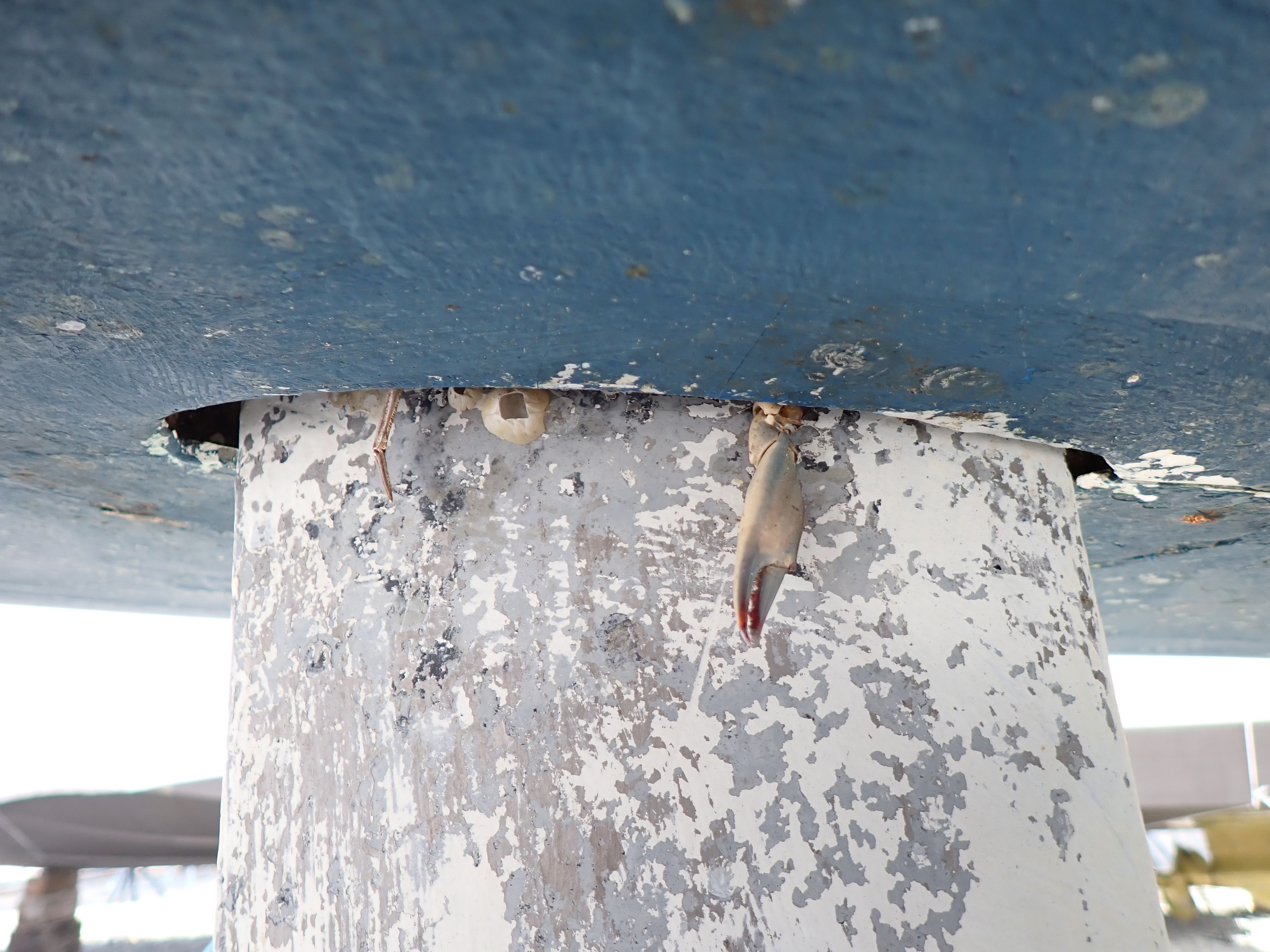
     I imagine he took up residence when he was small, and then one day learned he was stuck. [sail drive]


    I'm currently 22 months into a 24+ month evaluation of bottom paints in the Chesapeake Bay for Practical Sailor Magazine. More than 20 samples and 6 different paints on my boat. In spite of copper leach rate restrictions, and to the credit of the paint manufactures and the EPA, we seem to have a crop of paints that are quite effective and kinder to the environment.

    I have conventional foul weather gear, but my winter sailing gear is based on waterproof socks in deck shoes, snow board pants, and a windbreaker over fleece. When it gets colder, add a balaclava and a warmer parka. I love the new Gill Helmsman gloves (the only insulated gloves I can really sail and work winches with), and ski goggles come out when it gets close to freezing.


    Wednesday, May 18, 2022

    If There is a Shortage of Both Gasoline and Food Brewing...

     ... Should corn go into fuel or food?

    In the past, since I didn't favor ethanol in gasoline for environmental and operational reasons, it seemed obvious. Food was a better use. But if both are short, and the international situation matters both in terms of food supply and fuel supply, which is should win the calculus?

    In the US, I assume the market will decide. The EPA's rules on gasoline blends have been relaxed, and the value in food and gasoline has gone up. Jump ball, I guess, since we have enough and export both.

    In Europe, I'm guessing gasoline wins. 

     In the third world, I imagine food wins, except where sugar cane is used to make ethanol, there really isn't the same export demand for cane.

    It's a shame people can't just play nice. I thought, or at least naively hoped, we had outgrown this, on this scale.

    ---

    Assuming we're looking at E15...

    • Use Biobor EB or Stabil 360 Marine. They really help with corrosion, which is the main cause of carb jet plugging.
    • Keep your jets clean. Ethanol runs leaner than gas, meaning you need about 5% more E15 through the jet than with gasoline. Small outboards are designed a little rich, but this tolerance will be reduced.
    • The vapor pressure is even greater than E10, so the pressure in sealed tanks will increase. Keep them out of the sun, paint them white (a flexible paint, such as inflatable paint or buoy paint, is required), or make a white cover.

    Tuesday, March 8, 2022

    The High Cost of Gasoline

     Let's see...

    • 2 trips per month
    • 12 months
    • About 1 quarts per trip ...

    Equals 6 gallons per year. At $5.00 per gallon, about 30 gallons per year or $1.25/trip.

    Then there is the case of the guy with 3 x 250 HP on the back, burning $375.00/hour.

    Then there are the fishmen, trolling for hours and hours at 3 knots. But really, they're only burning ~ 0.3 GPH at idle, so only a few gallons while trolling. Getting to and from the fishing grounds might be 5-10 gallons, if it's not far. So maybe $50-100 for the day.

    Plus carfare. Plus slip. Plus, plus, plus.... Maybe I should just buy a fish sandwich, even at only 1 quart per trip.

    Sunday, February 13, 2022

    Our New World

    On vaccines and masks:

     A great flood happened.

    A man was forced to climb to the second floor. He was looking out the window and a canoe passed. “Do you need help?” The people in the canoe called to the man. “Oh no, God will provide.” So the canoe went on it’s way.

    The water kept on rising and the man was forced to go onto his roof. He was sitting there looking around when a helicopter flew close by and a man inside called, “Hey! Need a lift?”, and the man said, “Oh no, God will provide!”

    The water rose even higher and the man drowned. He went up to heaven, met God and said, “I trusted you! You were supposed to provide!” And god said, “I sent you a canoe, and a helicopter!”

    ---

    He gave us a brain, the brain gave us reason, science that explains the reasons for good hygiene, and vaccines. We should probably be gracious for the gift of reason and use it. (From me, a complete atheist.)

    Times are changing and the bubble is opening. We are all thankful for the vaccine and natural immunities that have made this possible. But there is now a new virus in the world, it isn't going away, and we aren't going back to the good old days. In fact, the good old days were full of seasonal colds, the flu, polio, and lots of things that took children before they were adults, adults before they live a full life, and ruined our quality of life. They weren't really that good, and in fact, it seems we were just enjoying one of those idyllic interludes between periodic plagues, ice ages, and world wars. 

    Better to work our way through change, which is never easy. The pre-911 world is not coming back, but we have gotten used to it and hardly notice the differences unless we dwell futilly on the past, and some ways it is probably better.

    Adapt. Immune compromised people will need to remain vigilant and they will have to take more precautions; annual vaccines and mask wear in many settings. Healthy people will need to be courteous to others and take a few precautions that seem unnecessary to them. In the future there will be no "cover your mouth when you sneeze" or "cough into your elbow." If you have a cold or even allergies, politeness and good hygiene will demand you wear a mask, and not to wear a mask when you have the sneezes will be fundamentally rude. If you think about it, it has ALWAYS been rude and inconsiderate to spread your germs and make other people sick, but we all did it anyway. Now we have better tools not to.

    It no longer feels "weird" to wear a mask in the grocery store or office, so I hope we will when we should. It won't be all the time, but will be when we are sick or when some new surge comes along. It may be smart in an airport terminal, and on the same day superfluous in a quiet restaurant. We need to be thoughtful, and determine the difference, not based on politics or local fashion or the fashion of the moment, but based on the situation.

    It comes back to reason. I'm looking forward to wearing a mask only as needed, and at the same time, if I can be smart about it, avoiding seasonal colds and all the rest. That would be nice.


    Monday, May 17, 2021

    Beach Plastic. Micro-Plastics vs. Clean Burning

    A desert island question, or rather many remote areas, even in the US.

    You are on a beach with plastic debris. There is no access to recycling or safe land filling. The alternatives are open burning or ocean dumping, and as a practical matter, it will be left where it is. Do you:

    • Throw the plastic on the campfire to prevent micro plastic  pollution.
    • Burning the plastic more cleanly in a rocket stove or similar.
    • Leave it be.

    Further, I have studied beach plastic in my area and read studies world-wide. The main culprit of dioxins when plastic is burned IS PVC, and PVC sinks (it is heavier than water). There is NO PVC in beach plastic, only PET and LDPE, which are just carbon, hydrogen, and oxygen. They can smoke if burned with poor air mixing, but there is nothing in their chemistry that is more polluting to burn that wood.

    Also, drift wood contains elevated levels of chlorine. Seawater. But 20-40 times less than PVC plastic.

    Burning is never great, and even less so when the heat is not used for something necessary. Micro plastics are a problem, but how big a problem is far from established. Maybe very small, maybe a long-term time bomb. We don't know.

    I've read that this is also a problem in Nepal. A better stove is needed.

    • Trekers bring plastic. 
    • The locals have no trash disposal methods (they don't have plastic trash--they farm and they keep cattle).
    • They need fuel for cooking and heating, and they have little wood. The alternative may be yak dung.

    I've been doing some experiments with stoves that can burn beach plastics without smoke, far more cleaning than a typical cooking fire. I could cook a meal with plastic and not get any soot on the pot. But I don't know what I think about that.

    Monday, March 8, 2021

    Spring is Coming

     It's supposed to pass 60F next week. I won't know how to dress. Time for some fast sailing.

    It doesn't like like double digit speed, but it is. 

    I don't have many pictures in the high teens--I guess I'm busy!


    Sunday, February 21, 2021

    Drogue Chainplate Design

    rev. 7-25-2024

     Don Jordan, the father of the series drogues, suggested a chainplate of conservative dimensions, but did not detail the design. He wanted to keep it simple so that people would use them. Most commonly, these plates are installed horizontally, because that looks right. But what if the pull is not horizontal?

     The angle are exaggerated to make a point. Tank or model testing would could refine this. But I'm pretty sure that not all of the strike sure horizontal and thus the first few bolts are carrying most of the load.

    In my limited experience, and based on what I think is common sense, the strongest pulls are from a downwards angle. From basic engineering statics, the largest bending forces are near the transom end, and the largest shear loads on the bolts will be when the load is off-axis. That suggests either more or larger bolts near the transom, but more will better distribute the shear stress load to the laminate.

    Hardly a detailed analysis, just thinking. In practice, it would be simpler just to build it oversize, though internal reinforcement of the laminate might be avoided by this sort of design.


    Wednesday, February 17, 2021

    The Jawbone and Other Mysteries

     There we were, sailing across the Chesapeake in moderate winds when, something small and hard clattered into the cockpit from the masthead. For a moment were were terrified that i must be some critical pin, and that any moment the mast would go over the side. But upon closer inspection, it was a jawbone.

     
    A brief Google search confirmed it was most probably from a raccoon.
     
     
    But how did that get up there? I can only assume an owl was responsible, since I clean owl pellets off the deck now and them. Seems more likely than an osprey. 


    But then what explains this chunk of asphalt, neatly lodged on my aft starboard aka? I doubt a bird carried it. Why would a racoon, and besides, there were no sings of attempted forced entry, which I would  expect if raccoons were about.

    It's a puzzlement.


    Sunday, December 13, 2020

    Sunset Picture

     I'm not normally into sunset photos, but this one by a fellow F-boater (Farrier forum) caught my eye. The reflections look like fog floating on water. Very cool. Makes me miss summer. I avoid being on the water at sunset in the winter, because it is time to head home.

    It's not the cold that prevents me from cruising in the winter, it's the short days. I'd rather go home. And in truth, you get a lot of solitude during the day, on the water, so few people sail in the winter. Just me and the scotters.


    Wednesday, December 9, 2020

    The Wolf's Dictionary

    rev. 7-25-2024

    I posted this December  2020, after the last election but before it was certified. Little did I know where things were headed. Once again, I think the words of Abraham Lincoln have relevance.

    Democracy. Fair election processes. "Our freedom is under siege." I don't think these words mean the same thing to all people, so how can we have a conversation?

    Abraham Lincoln was confronted by this problem on a colossal scale. The rank and file on both sides believed to their very marrow that they were right and that their cause was just, even using the same words. Liberty and Freedom.


    Abraham Lincoln - Wikipedia


    "The world has never had a good definition of the word liberty, and the American people, just now, are much in want of one. We all declare for liberty; but in using the same word we do not all mean the same thing. With some the word liberty may mean for each man to do as he pleases with himself, and the product of his labor; while with others the same word may mean for some men to do as they please with other men, and the product of other men’s labor. Here are two, not only different, but incompatible things, called by the same name—liberty. And it follows that each of the things is, by the respective parties, called by two different and incompatible names—liberty and tyranny.

    The shepherd drives the wolf from the sheep’s throat, for which the sheep thanks the shepherd as a liberator, while the wolf denounces him for the same act as the destroyer of liberty, especially as the sheep was a black one. Plainly the sheep and the wolf are not agreed upon a definition of the word liberty; and precisely the same difference prevails to-day among us human creatures, even in the North, and all professing to love liberty. Hence we behold the processes by which thousands are daily passing from under the yoke of bondage, hailed by some as the advance of liberty, and bewailed by others as the destruction of all liberty. Recently, as it seems, the people of Maryland have been doing something to define liberty; and thanks to them that, in what they have done, the wolf’s dictionary, has been repudiated."

    This lack of a common dictionary tore the country apart. It seems we again diverging over what democracy and the Bill of Rights mean. I can accept nearly any political difference of opinion as a basic right. I've voted Republican and I have voted Democrat. But what I cannot abide is any disrespect for the Constitution and the IDEA of fair processes that it inspired. THAT is what makes us American. Respect for the process, whether we like the result or not. Only in a failed nation do people disrespect the process, and we are NOT a failed nation. I hope not.


    Saturday, November 28, 2020

    The Blue Book

     The Blue Book is where you find used car values, right? Well, not in 1906, when there weren't enough used cars to create a market or the demand for the Blue as we know it today.

     
    In fact, since roadmaps didn't really exist, it was a travel guide.
     

    It also provided some information regarding regulations. Remember, driver education and driving licenses did not exist yet.


    And then finally, there is the general non-existence of good roads and uniform signage.  For example, this description of the northern Virginia suburbs is interesting:
    • The road described as leading to Manassas is almost certainly route 7, but it had not been given a number. 
    • Manassas is west of Alexandria. Both are good size cities now.
    • It seems not even one car made the trip from Washington DC to Richmond each year. Now, it would be one car every few tenths of a second.


    I wish I could read through this with my grandfather (born 1898). He was learning to drive during this period, driving logging trucks without a license. The sections on Pennsylvania, where he lived often said things like "turn left at the large oak tree 2 miles past the church," in areas where we now drive the Pennsylvania Turnpike at over 70 MPH.


    Tuesday, November 17, 2020

    Fall Brings the Wind! And the Cold.


    90 degree heat and single-digit speeds suck.  A nice 15-knot breeze and speeds over 10 knots  make with worth the extra layers and a little nip on the nose. At least you can add more layers.


    What I does it take to keep warm? 

    50F
    • Soccer training pants.
    • Either water repellent wind pants or Gore-Tex, depending on how much spray.
    • Base lay fleece top.
    • Turtle neck.
    • Fleece pullover
    • Wind breaker or light Gore-Tex pullover.
    • Very thin balaclava. Keeps the neck warm, but more importantly, it locks the hat on.
    • Ball cap with bump cap insert or fleece hat.
    • Sunglasses (with bifocal).
    • Musto winter sailing gloves
    • Deck shoes.
    • Waterproof socks.

    30-40F

    • Add long underwear.
    • Add second fleece jacket.
    • Possibly heavier wind breaker. Possibly drysuit if really nasty.
    • Heavier balaclava.
    • Ski googles. Keeps you face a lot warmer, even if there is no spray. 
    • Disposable heaters for gloves. They really help, and they keep you in thinner gloves. But I also carry ski gloves (warm but not agile) and insulated waterproof coated gloves (Hydroflector--totally waterproof, excellent grip, and reasonably agile if fitted properly).
    • Thicker waterproof socks, or just a pair of fleece socks under the standard waterproof socks (not if wearing drysuit--waterproof feet are integral.
    • Sometimes Gore-Tex shoes instead of deck shoes. But less agile.

    So what am I testing for this season? 

    • Waterproof socks. I used them decades ago for hiking and was unimpressed, but I got several new pairs for this sailing season, and so far, they are a big winner. Comfortable, and they allow me to stay in deck shoes. Gill (top quality) and Randy Sun (great price) are contenders.
    • Seat cushions for a few more sitting locations. A foam pad adds comfort and warmth.
    • Fleece closures for companionway. In two separate layers, they will attach with Velcro, much like my mosquito screens. I don't do much cool/cold weather cruising any more, but they're nice even for a lunch stop. They go well with vented stove-top cabin heater.

    Featured in Good Old Boat Magazine, it is nothing more than an old stainless pot inverted over the burner, a flexible 1-inch flue, and a place to place a cooking pot on top of it. Great for warming the cabin and heating up left-overs, all while venting the combustion gasses and CO2 out of the cabin. Very efficient too; the flue is barely warm where it exits the cabin.


    Wednesday, November 4, 2020

    A Close Race?

    In fact a good many have been one by a single electoral college vote.

    history of close races 

    The voter turnout is the striking thing. Over the past few decades, 60-65% of registered voters was typical, with very little fluctuation. This time the total looks to be closer to 80%. Of course, only about 2/3 of qualified voters registered, lowering that figure to about 50% participation. I guess 1/2 the people figure one vote does not matter and it's not worth their time.

    From a point of view, I guess it's surprising that even 1/2 the people can do anything together.


    Tuesday, November 3, 2020

    Hiding e15 in the E10 Pump

    I missed this one. We all heard when Trump ruled that e15 could be sold. What we missed, probably because it was only publicized in Iowa (tight election!), is that e15 can be put in an e10 pump without labeling it as such, subject only to state approval.

     reuters--e15 allowed in e10 pumps

     I'm not sure it's much of a news item. It may very well be reversed, and probably will never move far out of the heartland.  

     But the thing to remember is that marine engines, including outboards, do NOT have computers and CANNOT adjust to the leaner conditions this creates.

     boating industry mag. e15 in e10 pumps

     Be careful what gas you buy. E10 is sort of OK. e15 is probably OK in your car. But not in your outboard.

     ----

    Interestingly, this was announced mostly in Iowa 52 days before the election. Kinna obvious. If I lived in Iowa I'd ask "Why not three years ago? And will you change it back in a few months to court big oil... again?"

    ----

    Actually, it seems there is no such executive order. He just tweated that there would be. So he lied to Iowa?

    federal register--list of EOs

     If I'm wrong, post the link. I'd really like to see the text.

    Saturday, October 17, 2020

    The Common Clay

    Though I've been primarily working from home and observing, my work requires me to travel through rural areas and stop in travel plazas. The last I visited, just north of Haggerstown, MD, featured only 20% of the people wearing face coverings, and most of those had their noses sticking out. Honestly, wouldn't you feel pretty stupid with you nose sticking out, as though THAT part of you is clean in flu season?

    The Pennsylvania turnpike was better. Parts of Ohio were pretty shaky, more so in rural areas. My experiences in North Carolina were unimpressive, with the entire Subway restaurant staff going mask-free. I even declined my food in one McDonalds (Wooster OH) because the food prep staff and manager were mask free. I think it's clear the next Covid boom will be slower (because they are spread out) and across rural areas, because they just don't listen. 

    In my home neighborhood it's not like this. Mask wear is very high and climbing. I think I'll stay here. 

    This isn't about politics. This isn't about personal freedom. How child like. This is about nature and what it takes to staunch a plague. This is why they teach history and biology in school. It's not like work-changing pandemics are something new.

     From Blazing Saddles 

    Saturday, July 4, 2020

    The Ulitimate Laundry Tub Drain Strainer

    I don't know why it took me so long to reproduce for home use, a design I have used in industry for decades.

    • Never used wire mesh (bad) or expanded metal (worse). The corners of each opening form a wedge to trap fibers.
    • The strainer material should be about as thick as the hole diameter. This also reduces debris hang-up. It makes it more dificult to hang through and staple. It also makes for less friction when cleaning wrapped (stapled) fibers, since it is like a larger diameter pulley.
    • Flow outside-in if feasible. It is easier to clean the outside by just it wiping off. No digging.


    This laundry tub strainer was made from a 1.25-inch PVC stub glued inside a 1.5-inch riser, that was then drilled with 1/8-inch holes. The top is open. After drilling the holes, sand or scrape to get rid of all of the burs, but do NOT chamfer the holes; that will actually make it harder to clean.

    I could have drilled the holes more closely, but this was a trial version. The hole size I am happy with. Not matter how jammed, I can wipe it off with once swipe of my hand.  The open top means that if it clogs the tub will not overflow.

    I made another for a bathtub. Works great. One swipe to clean.

    ----

    Wire mesh and expanded metal are just cost-cutting measures. Perforated metal or plastic is always better. Boat applications? Cockpit drains come to mind. 

    Yup, any strainer that is hard to clean. There are companies that make custom strainers for big money, or you can make your own from PVC. Vary the hole size according to the application (but there is seldom good reason to go smaller than 3/32-inch--9/64-inch is industry standard for most plumbing), drill them closer, and a drill press is darn handy, because there are a lot of holes. Yes, you can buy perforated materials, but fabrication is another thing.