Showing posts with label Fishing. Show all posts

Tuesday, February 8, 2022

Mano a Mano

I enjoy the simplicity of trolling for big rockfish with a cuban yo-yo. I can keep the sinkers and long leaders rigged, they take no space to store so I can easily keep many different rigs prepared, they rig to the rail quickly, and most of all, they work.

Rockfish (striped bass)--38 inches
Caught on a large swimming plug at ~ 4 knots

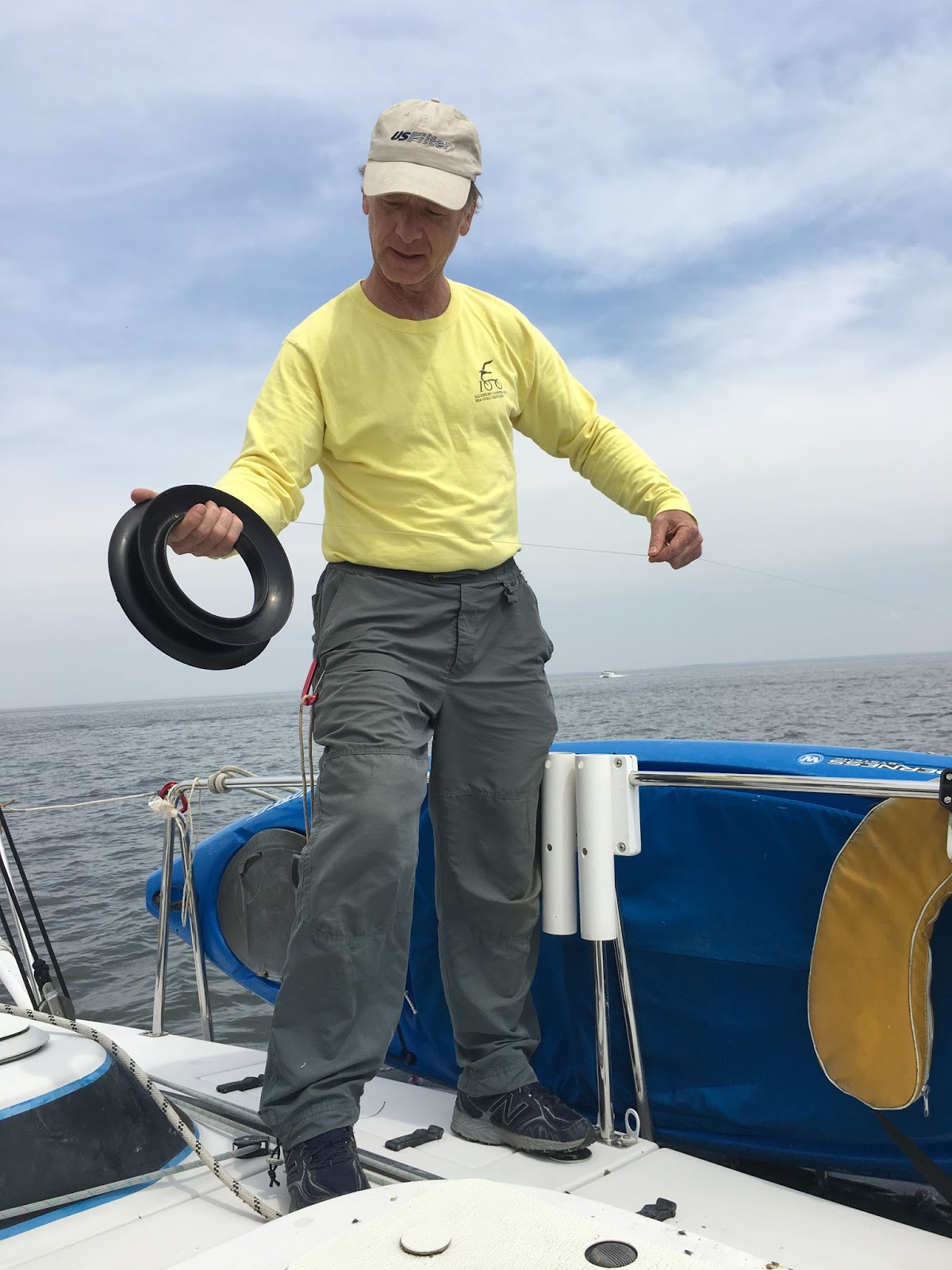
I've been told a large fish will snap the line. Apparently not, certainly not today. The only rigs I've lost have been to crab pots I didn't see. I've been told you need a bungee cord shock absorber. Since I troll 150 feet of 80-pound mono-filament and that can stretch 10 times as far as any reasonable bungee cord, the bungee cord makes little sense if you actually do the math; an additional 30 feet of line will do as much. I've been told you can't play a large fish. Well, I landed the above 38-incher in minutes without gloves and no strain. I did walk up and down the side decks a bit for this one; she started running toward the boat faster than I could wind, but not faster than I could easily walk and wind.

Mostly, I like the Old Man and the Sea, whether the book, or the performances by Spencer Tracy or Anthony Quinn. There is something basic about pulling in a fish in with minimal technology. Fishing should be a simple thing, man against prey--it's nothing when reduced to an arms race, graphite composites and fish finders and stainless steel and all of human technology, against a simple fish.

_______________________

Note to sailors: you've got to slow down to catch rockfish; 3.5 to 4.5 knots seems to be the best range. Later in the summer, particularly in the southern Chesapeake, you may catch bluefish at 6-8 knots.

Saturday, August 11, 2018

Dual Rod Holder From Scraps

Or rather from a stern rail motor mount that the the PO liked but I had removed. In my mind, either the engine should be able to stay on the dingy or...
  • The davits or hoist is weak. Upgrade.
  • The engine is too damn big.
  • The dingy moves too much, in which case it should be triced-up.
  • The dingy is vulnerable in rough weather. Not the case on most catamarans, since the davits are forward of the transoms.
The mount has been resting in a might-need drawer for 6 years but now enjoys new life.

It's primary purpose is to hold my 2 mini-outriggers (2 x 6' outriggers give me an effective beam of  26 feet, easily trailing 3-4 lines without tangles) while not trolling. They can't left in place during docking, and placing them in the outboard rod holds inhibits easy boarding and blocks the holders for other uses. I find rod holders handy for other things as well--boat hooks, walking sticks, gaffs, oars--so i can never have too many.

I dislike commercial holders since they only grip the rail without twisting if tightened so much they scar the rail. This never will, since it uses an up-right for bracing.


Construction was simple enough. I had to slot the back to accommodate a brace. The 2" SCH 40 pipe is attached with counter sunk #10 machine screws. In the background are a pair of kayaks lashed to the top of the davits, the most convenient storage space.


The lures are home-made too.

Wednesday, September 10, 2014

Re-hooking

After about 5 years of faithful service, my collection of saltwater plugs was looking sad. One fish lost to a hook that snapped off, a little too much metal gone. Time for new teeth.


Is it worth the trouble for a few lures? These are good sized lures, $10-$15 each for 8 of them, so yeah, time well spent. About $2 for the hooks and 15 minutes work, they should serve another 5 years. It's also good to inspect the rig, trim the end off, and tie new knots.

Other lures are generally just replaced. Jigs are cast in one piece, and generally the skirt goes first. Blue fish hose eels are generally too chewed up to worry over, and the stainless hooks last forever.

Saturday, August 25, 2012

Food Fishing

No deep sea fishing or big prize money here. Just meat-and-potatoes food fishing.

That's a fish. 41-inch Rockfish on a stretch plug. The gear consisted of 250 feet of 100-pound mono, a 2-ounce in-line torpedo sinker, and a Cuban Yo-yo.

You do NOT handle the line with you fingers. It's more like winding in a kite, with a figure 8 motion.


We trolled a hose eel on a yo-yo at 6-7 knots from Point No Point to Smith Point under sail and were rewarded with a pair of snapper blues. A home-made lure, tied from a bit of surgical hose, mono, an S-hook and a stainless fishhook; the purchased hose eel on the other transom caught nothing. We scaped (yes, that is the correct local spelling) crabs from dock pilings in Tangier for an hour and collected a bucket full.

Seafood feast at Tangier Island

Introducing whole crabs to a newby is always a treat. The fresh taste rewarding persistence and thoughtful exploration of the carcass.

For sand sharks we have great success with grass shrimp, mostly because we can always get them off the pilings with a net and thus fish with them a lot. Sea bass like them too. A bass rod is about right.


 Shark fishing, Cape May. Particularly good with onions and Old Bay. No bones.


Fancy? No. Fresh? Certainly. Full by meals end? Oh my.


Fishing and Cigars

Honestly, I wouldn't have guessed what these share in common. Though I keep Shoal Survivor in a fishing harbor and visit fishing towns, I was never immersed or really even exposted to the off-shore bill fishing culture. It's just a little bit about showing off.


Cigars. Boats averaging ~ 1-2 million dollars. Cute off-shore fishing clothing and beer guts. Lots of bling on the brainless trophy wife or grl friend. 8-10 crew members to rinse and pollish he boat between the jetty and the dock, so that it will always show best. The crew finds the fish, prepares all of the fishing gear, sets the hook, and only then does the owner winch in the prize and claim all credit. Whoppee.

One by one, the boats back in with the one or two fish they think might be worthy (smaller fish are tossed over the side, if reports indicate they are out of the money). Pictures are taken, fish wieghed and measured. Then a biologists inspect the fish and checks for hidden weights and liquid injections. Trust but verify. In reality, as much cheating as NASCAR.

The Mid-Atlantic $500,000, fished primarily out of Ocean City and Cape May. Total prize money runs about $1,500,000 to $1,700,000, depending on the year. A late summer tradition, loud and crazy and marina-filling. My daughter, her friend and I dingied over to what the final day's weight-in to watch the specticle. The closing party continued into the wee hours.

__________________


Next year, I simply need to scrape up the entrance fee (ranges from $1,000 to $7,000, depending on the catagories). Or perhaps I'll just troll for the ocational blue or rockfish and leave it at that.

Sunday, May 15, 2011

A Minnow Trap from Recycled Flotsom

My back has flared up in annual protest for some perceived slight. I can't sail, I can't ride, I can barely walk. I can post something trivial.

Collecting critters and fishing may not be sailing, but I love them both. Even more, I love introducing my daughter to the natural world. Add to that father -daughter time the opportunity to teach a D-I-Y ethic, recycling and thrift all in one stroke; a bargain.


Any plastic bottle with a cap will do. Two are required. Any beat-up thing from the wrack line will do. 2-liter jugs are best, but even 12-ounce bottles do well.
  • Cut the bottom off one.
  • Cut the top off the other and insert it inverted. Leave the cap on the external neck only--it's handy for decanting the catch. The other neck, of course, is the entrance.
  • Secure them together. I've seen everything from staples to cable ties to bolts to bits of string.
  • Poke a few 1/8 holes near the neck to allow some water flow, carrying the scent of the bait our the inverted opening. Additional holes only attract fish away from the trap entrance.
  • Tie a string around the neck to orient the neck into the flow, if any.
  • Add bait. Bread is a good starting point.
We've caught minnows, spring peepers, small crabs, grass shrimp, and eels.

Something to entertain the kids and an idea to keep in your tool box for your next Cast-Away adventure.
 _____________________________________


 Post Script. We actually carry a commercial minnow trap, which gets heavy use, both at the dock and at anchor (use care at anchor not to wrap the line around the rudders--just enough line to get it to the bottom).

Thursday, April 21, 2011

Rockfish Season

A dull mini trip report. I warned you.

April 16th, or there abouts depending on  the year, marks the practical start of fishing on the Chesapeake with the opening of rockfish season. Crowds of boats create a near-party atmosphere, and perhaps a little pressure not to strike out. Since the minimum keeper is 30 inches, you have to catch real fish!

Predictably, the weather in April can be nasty, and this year brought cold, near gale conditions, and rain. A few days later the sun came out, the temperature hit 85F, and the wind was predicted to be 15-20 knots with gusts to 25 knots. Good for a sailor, if a bit much for fishing.

Also good for tempting my daughter and a friend--it was Spring Break--to join me. Winter sailing tends to be a solo affair. A good opportunity for some early season sunburn. We blasted to the weather on a very close reach under reefed sails at 8-9 knots until suitably upwind, ready to turn troll homewards for rockfish. A nice warm, gusty wind. Some chop, but not bad. Delight. Jessica elected to sit on the tramp and get soaked with 55F water. Oh, to be young again... no, I think not.

The yo-yos are mounted center, port, and starboard, and 2 more on 7-foot outriggers (bamboo poles, one hidden from view behind the mainsheet). We tried a variety of lures. For us, large Rapella diving plugs work for rockfish, and yellow hose eels for blues. But I try other thing occasionally, since someone always swears by something different.

More on yo-yo fishing here: Yo Yo Fishing


After helping dropping the main and turning down wind--3-5 knots is optimum for tempting rockfish so only a bit of jib is needed--the kids retreated to the port cabin for dry clothes and warmth; yes, it was 80F, but not when wet. The wind died and the seas settled, I set 5 yo-yos with an assortment of lures, and sat back to, well, do nothing. To listen to the lines squeak and waves slap. Unfortunately, 15 minutes into that bliss one of the yo-yos tripped--fish on! After winding in 150 feet of 80-pound test line we were rewarded with a 20-inch throw back, but rules are rules, never mind that same fish is available in the market every day. But that fish is different, caught off-shore beyond the reach of regulations, and that makes... some... difference. Still, even a throw back is better than getting skunked.

The VHF warned of a nasty gust front approaching (40 knots), so we made for a beach closer to the harbor; if we  were caught there, anchored, there would be no troubles. Why ruin a lazy day with work. The kids walked the beach and hunted fossil sharks teeth, while I finish a beer and and old movie. They returned, we tried to fall asleep on the tramp, and then headed in.
Of course, we reached the dock along with the gust front. It took 3 passes at the slip to out smart a brisk beam wind, but dock rash was avoided through firm application of throttle.

And I spent a few minutes fooling with fitting my new solar panels (2 x 85 watts). I came up with an adjustable leg design I'm happy with; it compensates for the arch of the deck, provides for cooling, and since I'll epoxy them on, avoids holes. I'll post something when the protect is complete.

A nice day.


The foot is 1/2-inch pre-laminated FRP with a 1/4-inch x 1 1/2-inch stainless rod tapped and epoxied in. It will glue to the deck with thickened West System epoxy.

Monday, May 31, 2010

Retribution

On the Chesapeake, even though fishermen trolling have no navigational right-of-way, I've noticed that most sailors are polite and don't demand rights on the open water where trolling is common. Everyone gives your transom wide berth, recognizing you have gear in the water as much as 300 feet back.

25 years ago, when I had a Prindle 16 catamaran (no engine) I was trolling for bluefish on the lower Potomac, when a waterski boat decided it would be funny to do a loop around my boat, quite close. Suddenly, one the reels started to scream, all the line ran out, and it broke off at the spool - unusual, because line generally breaks at the lure end, but I didn't think much about it.

I had already caught one good fish, the skier expereince had bummed me out, and so I stopped fishing and just sailed for a few more hours, wandering my way back to the launch ramp. I de-rigged my boat, secured it on the trailer, and then noticed that the ski boat was back on its trailer too, a swarm of guys hovering around stern drive. It had been towed in.

I wandered over, curious - morbidly - to hear what misfortune had befallen the JERKS when I saw a something familiar. My lure, a 12-inch hose eel, was hanging from his drive. It seems the wire leader had cut through the oil seal, the lube had run out, and in several hours of hard running, he had fried his stern drive.

I walked over, cut my lure free with a multi-tool I had in my pocket, and thanked him from returning my lure. I left for home, directly.

Sunday, April 11, 2010

Yo-Yo Fishing

rev. 3/18/2011

If you hail from south Florida or the Caribbean, you should already know this one; the Cuban yo-yo. In it's basic form, it is fishing reduced to its origins; hand lining. Popular in Cuba, is has been brought to south Florida and is quite enjoyable for its shear simplicity. Toss a few yo-yos in a bucket and you can catch some fish. Perfect for a crowded cruising boat or a small day-sailer. Rigged as a simple trolling set-up, catching game fish under sail couldn't be simpler.

The Yo-Yo. There are 2 sizes: the 6-inch inside diameter size is best for hand lining and comes loaded with 300 feet of 40-pound test line, a 1-ounce sinker, and a hook; the 8-inch inside diameter size is typically sold empty and is well suited to the trolling set-up I will describe below. Both are simple spools designed with simple features that make a big difference:
  • Wide, deep, and smooth, for easy line pay-out and secure storage.
  • Lower forward lip for better line pay-out.
  • Finger grip inside spool for secure grip while casting or winding in a big fish.
 Any Florida bait-and-tackle store will have these for a 3 to 5 dollars.


Handlining. Just bait up and lower over the side. To cast, let out about 3 feet of line, pinch the line against the side with your thumb, and whirl the bait and sinker over your head like a slingshot. Understandably, casting is a bad idea on the deck of a  sailboat, but solo in a tender or on the beach it works well. To reel in, simply wind the line back on the spool. If you hope to fight a large fish--and these can mange some big fish--sailing gloves are a good idea, though I almost always forget. You don't actually fight the fish with your hands--you use the reel. We keep two in our tender all summer. We loved "The Old Man and the Sea" and this takes us there. Yo-yo demonstration

 A source for yo yos: Bass Pro Shops
(Only 6-inch yo-yos. They do not stock yo-yos in the stores.)

Another source: Palm Bay Bait and Tackle

And yet another source: http://www.stingraytackle.com/9incubanreelyoyo.aspx
(I just bought a few 9-inch yo-yos from these folks (March 2011) since I'm not traveling to Florida soon.)

A source for wooden yo-yos, if you must be completely traditional: http://www.fishingyoyo.com/about-us.html

A source for flat line clips: Bass Pro Shops
(Flat line clips can also be made from tarp clips for a fraction of the price; available from Home Depot or most hardware stores, simply line the teeth with a layer of athletic tape. tarp clips)

  
Trolling. Though not the original purpose of the yo-yo, this is where they shine. Although I do carry trolling rods, the yo-yos catch most of our fish, because they are fast to rig and consequently, we use them more often. They are compact, quick to rig because the line, leader, and lure can be stored assembled, and tangle-free.

  • Load the yo-yo with 150 to 200 feet of 60- to 100-pound test line. Attach the line to the yo-yo with a slip knot with a fishermans knot or improved clinch knot.
  • Add a trolling sinker, 2-6 ounces, to suit typical depths and speed. Some fish (mahi-mahi and other bluewater fish) prefer surface lures that incorporate all the weight that is needed.
  • Add a 20 foot leader, to separate the lure from the sinker.
  • Pick a lure. I like 6- to 8-inch Rapella diving minnows for bluefish and striped bass. I also use bunker spoons and hose eels. However, the best bet is to match what the local charter boats rig. Rubber fish, feather lures, and squid-types are popular for bluewater game fish.
  • Let out all of the line at a suitable speed; 3-4 knots for striped bass, 4-6 knots for blues, mackerel, and bluewater game fish, though these are just guidelines.
  • Attach the yo-yo to the stern rail with a sling and carabiner. Some suggest a bungee cord attachment, to help absorb the strike of a big fish. They haven't done the math; the stretch inherent in the 200 feet of line you have out is more than enough--it will easily stretch 10-20 feet with a big fish--and any difference is in the head. I've had a 36-inch rockfish strike while I had the yo-yo in my hand, adjusting something, and the strike was nothing more than a steady pull. I've only lost a few lures, but I believe they were crab pot snags, not big fish. I've caught rockfish up to 39 inches with little strain on the gear.
  • Clip the line about 2 feet out to a flat line clip (a loop of line will give a cleaner release), removing the tension from the yo-yo and allowing it to hang down; in this way, you can see a hit. The pictures should make this clear: the top shows a yo-yo with a fish on, while the bottom is set with the line clipped to the trolling release (flat line clip).
The yo-yos are mounted center, port, and starboard, and 2 more on 7-foot outriggers (bamboo poles hidden behind the mainsheet). We tried a variety of lures. For us, large Rapella diving plugs work for rockfish, and yellow hose eels for blues. But I try other thing occasionally, since someone always swears by something different.

Our typical trolling set-up includes 3 yo-yos--one each corner and a trolling rod in the center, though the center line seldom hits. Sometimes we set 5--2 more on outriggers. But when not purposefully fishing, we may just set a single yo-yo on a corner railing. Our catamaran has a 16-foot beam and this gives adequate line separation; with a narrower transom, only two lines should be set. They it  store in a cockpit locker and can be set in a minute.


Where to fish? That is the trick, and local knowledge is best. But for a start, channel edges and off the beach in about 25-40 feet of water are good places to start.


It works!


------------

And from the United Nations, this summary of village fishing methods for the third world.